
Selling bus tickets online is one of the clearest ways to grow a transport business, because the same buses earn more when seats sell every hour of the day instead of only at a staffed counter. The good news is that you no longer need a large development budget to get there. This guide walks through how to start a bus booking business step by step, from your routes to your first online sale.
Step 1: Decide what kind of bus booking business you are building
Before any software, be clear on your model, because it shapes every decision that follows.
- Own-fleet operator. You run your own buses and sell your own seats online. Simplest to start and the most common model.
- Ticketing agency. You sell tickets for several operators and earn a margin or fee on each seat.
- Transport marketplace. You list many operators, approve them, and earn a commission on every booking without owning a single bus.
You can begin as an own-fleet operator and add other operators later, which is exactly how many regional booking sites grew.
Step 2: Choose your routes and market
Start where demand is clearest rather than trying to cover everything. Pick your busiest two or three routes, confirm realistic departure times, and note the boarding and dropping points passengers actually ask for. Decide whether you serve one country or cross-border travel, because that affects the currencies and languages you will switch on. A focused launch on strong routes builds reviews and momentum faster than a thin spread across many weak ones.
Step 3: Pick a platform instead of coding from scratch
This is the decision that most affects your budget and timeline. Building a bus reservation system from zero means months of development and a large bill before you sell a single seat. A ready platform gives you seat maps, e-ticketing, payments and an admin dashboard on day one.
| Approach | Time to launch | Typical cost |
|---|---|---|
| Custom build from scratch | Months | Very high, plus ongoing dev |
| Ready platform (e.g. X-Bus) | Days | One-time, far lower |
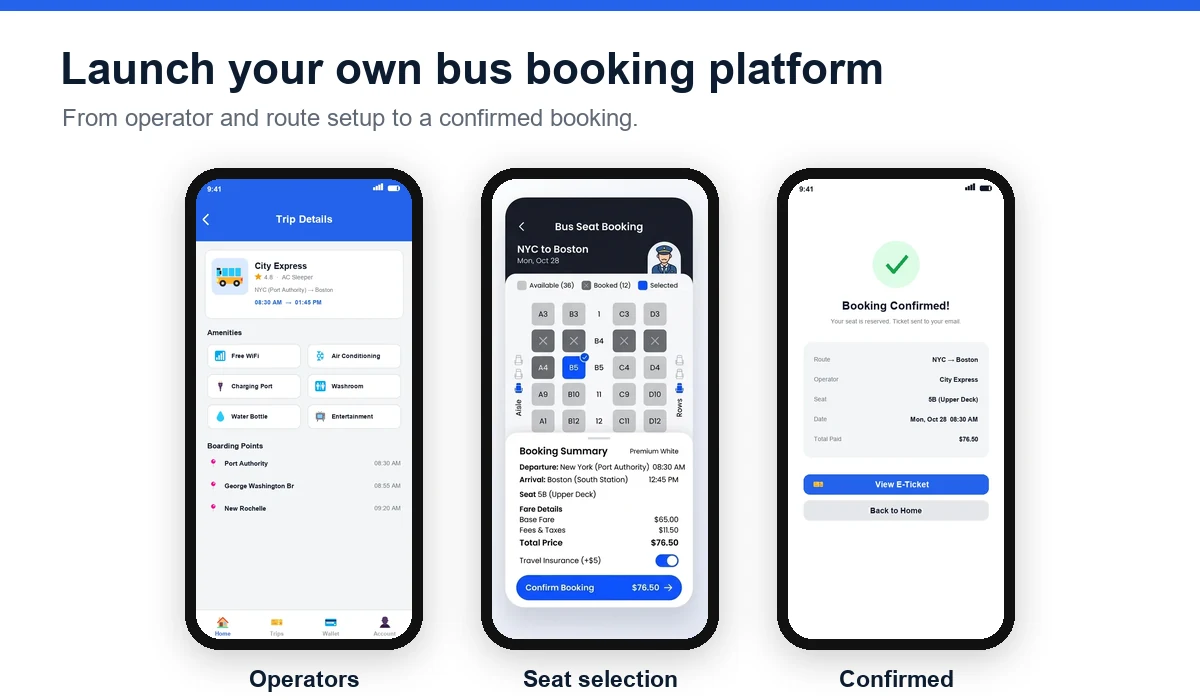
Our X-Bus platform is a ready bus booking and ticketing system you own outright, with the full Laravel source code, so you launch quickly and still customise freely.
Step 4: Set up hosting and a domain
Your booking site needs a professional domain, such as your company name, and reliable web hosting that can handle traffic spikes around holidays and festivals, when everyone books at once. Add an SSL certificate so payments are secure and passengers trust the site. A capable platform runs on standard hosting, so this step is affordable. If you prefer, our team sets up hosting, the domain and SSL for you as part of installation.
Step 5: Install and brand the platform
Once hosting is ready, the platform is installed and made yours: your logo, colours, company name and contact details, so it feels like your brand from the first screen rather than generic software. With X-Bus, the Professional and Enterprise packages include full installation and server setup, so you are not left with a technical project. This is also where you set your default currency, language and timezone.
Step 6: Add your buses, routes and seat layouts
Now you fill the system with what you actually sell:
- Buses: add each vehicle type with its seat layout, including deck, sleeper or standard seating and amenities.
- Routes: set origins, destinations, stops, boarding and dropping points.
- Trips and schedules: add departure times and recurring schedules so trips generate automatically.
- Fares: set prices per route, with any seasonal or weekend variations.
Accurate seat layouts and boarding points matter most here, because they are what passengers see and rely on at the roadside.
Step 7: Connect payment gateways and currencies
A booking business lives on smooth payments. Connect the gateways your passengers actually use, such as Stripe, PayPal, local card processors and, where relevant, cash-on-boarding or bank transfer. If you serve more than one country, switch on multi-currency so travellers pay in their own currency and multi-language so the site reads naturally to them. Test that invoices and refunds generate correctly, because refunds are part of normal operation and must work cleanly.
Step 8: Test the full booking flow yourself
Before you tell anyone about the site, make a real booking on it. Search a route, pick a seat, pay with a test or live card, and confirm you receive the e-ticket by email and SMS. Then check that the seat is now locked and cannot be sold again. Try a cancellation and refund too. Nothing reveals a problem faster than completing a real booking, and fixing it now is far better than a passenger finding it at the boarding point.
Step 9: Launch and market your routes
With a working site, it is time to bring in bookings. The most effective early marketing for a bus business is usually local and route-specific:
- Google Business Profile and local search, so people searching your route find you.
- Route-based social media targeting the cities and towns you connect.
- Direct booking incentives, such as a small discount for booking on your own site instead of an aggregator.
- On-bus and counter signage with a QR code that sends existing passengers to your site for their next trip.
- SEO content for searches like your route plus "bus ticket", which brings steady free traffic.
Our guide to the SEO checklist for small business helps your booking site rank for the routes you run.
Step 10: Grow with operators, offers and data
Once your own routes sell well, you can grow in several directions. Add more routes and boarding points as demand appears. Invite other operators to list on your platform and earn a commission on their seats, turning your site into a marketplace. Use the reports to see your most profitable routes and quietest departures, then adjust schedules and run targeted offers and coupons to fill the gaps. Because you own the passenger data, you can email past travellers about new routes and seasonal deals, which is far cheaper than buying every booking through ads.
How much does it cost to start?
The honest answer is that it is far less than most operators expect. The main costs are a one-time platform licence, hosting and a domain, and optional installation help. With a ready platform such as X-Bus, there is no large development bill and no monthly software rent, so the running cost is mostly hosting plus payment-gateway fees. That is what makes online bus booking realistic for a small operator, not only for national chains.
| Item | Typical cost |
|---|---|
| X-Bus platform (one-time) | From $299 |
| Web hosting | Low monthly or yearly |
| Domain and SSL | Small yearly fee |
| Payment gateway | Per-transaction fee only |
Common mistakes to avoid
- Launching too broad. Trying to cover every route at once spreads your marketing thin; start with your strongest routes.
- Ignoring mobile. A booking flow that is awkward on a phone loses most of your potential online sales.
- Only selling through aggregators. Convenient at first, but they take a commission and own your passengers. Your own site keeps both.
- Skipping the test booking. Always complete a real booking, payment and refund before launch.
- Renting closed software. Owning the source code keeps you in control of pricing, branding and data.
Common questions
Do I need my own buses to start?
No. You can run an agency or marketplace that sells other operators' seats and earns a margin or commission, without owning a single vehicle. Many booking businesses start exactly this way.
How fast can I be selling tickets online?
With a ready platform such as X-Bus, a focused launch on a few routes can be live in days rather than months, especially if you choose a package that includes installation.
Can passengers pay in cash?
Yes, where you want it. Alongside cards and online gateways, you can allow pay-on-boarding or bank transfer options, which matter in many markets.
Who this business suits
A bus booking business is not only for large national coach lines. It suits a wide range of people, which is part of why it is such an accessible venture today. An existing operator with a few buses and fixed routes is the most natural fit, simply moving sales online to fill more seats. A travel agency or counter already selling tickets can formalise and grow by taking bookings on its own site. An entrepreneur with no buses at all can build a marketplace that lists other operators and earns a commission, competing on technology and service rather than fleet size. Even a tourism or shuttle operator with seasonal demand can use online booking to sell in advance and smooth its income. What these all share is a simple truth: seats are a perishable product, and software that sells them around the clock turns empty seats into revenue. If you have routes, or access to operators who do, the model can work at almost any scale.
How to price your tickets online
Pricing is one of the first real decisions you will make, and it sets the tone for how passengers see your service. A sensible starting point is to match or slightly beat the fare passengers would pay through an aggregator, because you are saving the commission anyway and a small direct-booking advantage pulls traffic to your own site. From there, the software lets you be smarter than a flat price. You can set peak and off-peak fares so busy weekend departures earn more while quiet mid-week trips attract price-sensitive travellers. You can offer early-bird pricing to fill seats in advance, premium prices for front-row or lower-deck seats, and promo codes to win first-time passengers. The key is to keep the headline fare honest and let the extras do the work, because a clear, fair base price builds the trust that keeps people booking directly with you.
Building trust so passengers book with confidence
Passengers are handing money to a bus service they may not know well, often for a journey that matters to them, so trust is the quiet thing that decides whether they complete the booking. Several small signals add up. A professional, branded site with clear photos and route information looks established rather than improvised. Secure, visibly encrypted payment and an SSL padlock reassure people at the checkout. Genuine reviews and ratings from past passengers carry more weight than any claim you make about yourself. Clear, easy-to-find cancellation and refund rules remove the fear of being stuck if plans change. Responsive support, whether by phone, WhatsApp or email, tells passengers a real team stands behind the ticket. None of these are expensive, but together they turn hesitant first-time visitors into confident bookers, and confident bookers into the repeat passengers who make the business profitable.
Start your bus booking business with X-Bus
X-Bus gives you everything in this guide in one ready platform: routes, trips, seat maps, e-ticketing, boarding points, payments, offers and reports, with multi-currency, multi-language and multi-operator support and the full source code included. Choose Basic at $299 to launch with a guide, Professional at $599 for full installation and server setup, or Enterprise at $1000 for a large multi-operator marketplace. Every plan includes six months of support. To begin, see the X-Bus product page and message our team for a demo.
In short
Starting a bus booking business comes down to choosing your routes, owning a ready platform instead of building one, setting up hosting and payments, loading your buses and schedules, testing a real booking, then launching and marketing your strongest routes. Do that and the same fleet starts earning from seats that a counter alone would leave empty. When you are ready, our team can set the whole system up and brand it for you.