
Anyone who has booked a hotel or a flight online has used travel booking software, even if they never heard the term. It is the system that shows what is available, takes the payment and sends the confirmation, all without a phone call. For a travel business, owning that system instead of paying commission to someone else can change everything. This guide explains what it is and how it works.
What is travel booking software?
Travel booking software is an online system for selling travel services and managing the reservations. On the customer's side it is a website and app where people search, choose, pay and receive a confirmation. On the owner's side it is an admin dashboard that manages listings, availability, prices, payments, customers and reports.
It automates the whole booking process so it runs around the clock without staff. A traveller in another time zone can book a room at three in the morning, pay securely and get an instant confirmation, while the owner sleeps. And because it is software you own, you keep the customer relationship and the revenue instead of handing a commission to a global marketplace on every sale.
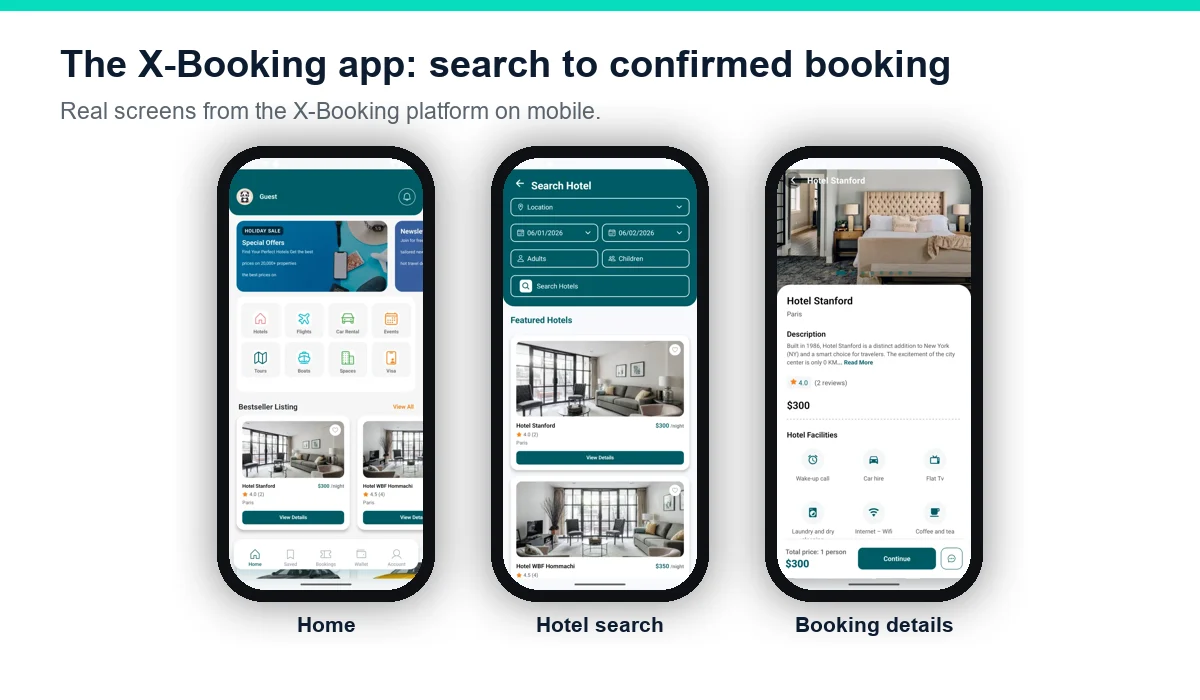
How online booking systems work
Whatever the booking type, the flow is consistent, and understanding it helps you see what the software is doing for you.
- Search. The customer filters by destination, dates, number of people and price. The system shows only what is genuinely available for those dates.
- Select. They choose a specific room, tour, car, seat or ticket and review the details and total price, including any taxes or fees.
- Pay. Checkout takes payment securely through a gateway such as Stripe or PayPal, in the customer's own currency where supported.
- Confirm. The moment payment clears, the system reserves the inventory, emails a confirmation and invoice, and updates availability so the same slot cannot be sold twice.
- Manage. The owner sees the booking in the dashboard, where they track payments, handle changes or cancellations, and request a review afterwards.
What can you sell with travel booking software?
Older systems handled only one thing, usually hotels. Modern platforms are modular, so one system can sell many kinds of travel from the same dashboard.
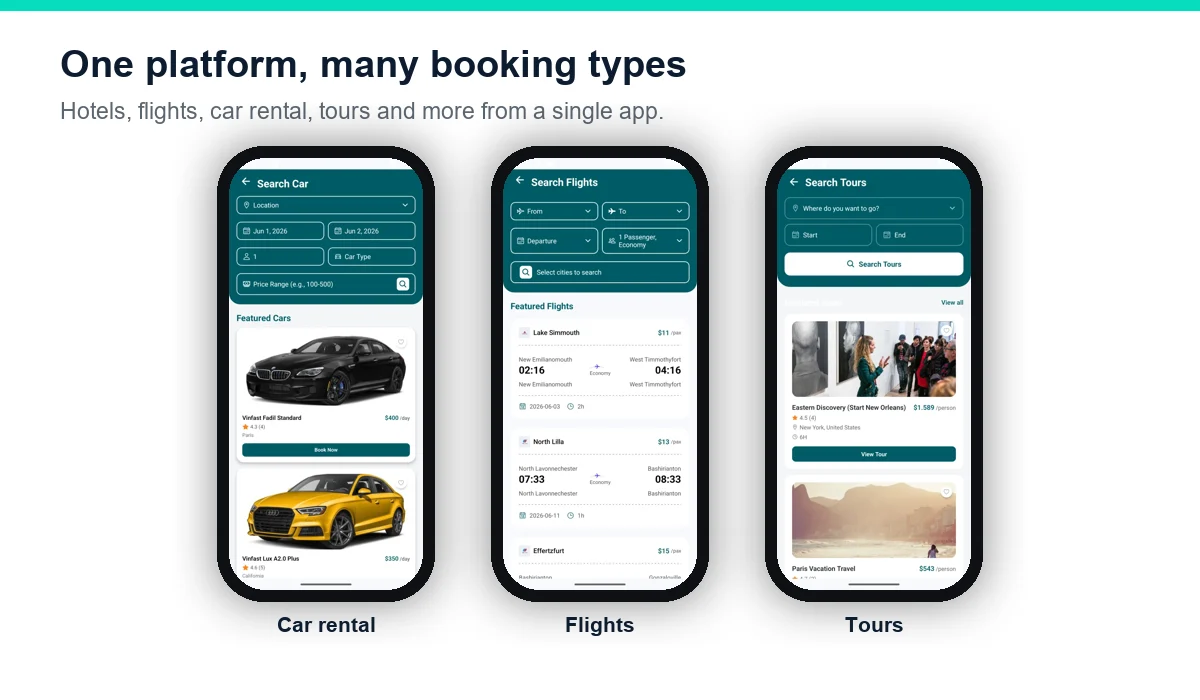
- Hotels and stays: rooms, rates, seasons and availability calendars.
- Tours and activities: schedules, group sizes and guides.
- Car rental: fleet, pickup points, insurance and extras.
- Flights: routes, fares and passenger details.
- Events: tickets, seating and promo codes.
- Boat charter: yachts and cruises with time slots.
- Bus booking: seats, routes and timetables.
- Visa processing: applications, documents and status tracking.
- Space rental: venues, halls and co-working spaces.
Our X-Booking platform includes all of these as modules, so you can switch on exactly the booking types your business needs.
Who uses travel booking software?
- Hotels, guesthouses and resorts taking direct bookings without paying marketplace commission.
- Travel agencies and tour operators selling packages and activities online.
- Car rental and transport companies managing a fleet and timetable.
- Event organisers selling tickets with assigned seating.
- Online travel agencies (OTAs) listing many providers in one marketplace.
Key features that matter
When you compare booking systems, these are the features that separate a professional platform from a basic script.
| Feature | Why it matters |
|---|---|
| Real-time availability | Live calendars prevent double bookings and overselling. |
| Secure payments | Stripe, PayPal and local gateways with automatic invoices. |
| Multi-currency | Customers browse and pay in their own currency. |
| Multi-language | Serve international travellers in their own language. |
| Automated emails | Confirmations, reminders and review requests sent for you. |
| Reports and exports | Revenue, payouts and statistics in PDF and Excel. |
We compare these in depth in our guide to the best online booking system features.
Why own your booking system instead of renting one?
Global marketplaces bring customers, but they charge a commission on every booking, hold the customer relationship and control your pricing and visibility. Owning your booking software flips that around:
- You keep the commission that would otherwise go to a marketplace on every sale.
- You own the customer data and can market to past guests directly.
- You control the brand and experience from search to confirmation email.
- You set your own rules on pricing, cancellation and availability.
Most businesses use both: marketplaces for reach, and their own booking site to take direct, commission-free bookings from the audience they already have.
The technology behind it
A capable platform such as X-Booking is built on Laravel, a secure and widely used framework, and runs on standard web hosting, so it is affordable to operate. It connects to payment gateways for secure checkout, supports multiple currencies and languages out of the box, and can run as a multi-vendor marketplace where other businesses list while you earn a commission. Because you receive the full source code, nothing stops you customising the design or workflows later.
Direct bookings vs marketplaces: the commission problem
It is worth understanding the money, because this is usually why businesses move to their own system. When a guest books your hotel through a large marketplace, that marketplace can take a double-digit percentage of the booking as commission. On thin travel margins, that is often the difference between a profitable month and a flat one. Your own booking site takes direct reservations with no commission to anyone, so more of every sale stays with you. The smart approach is to use marketplaces for the reach they bring, while steadily driving repeat and referred customers to your own site, where each booking is worth more to you.
How booking software helps different businesses
The same platform solves very different problems depending on who is using it:
- A hotel or guesthouse replaces phone-and-paper reservations with a live calendar, takes deposits online, and stops double bookings during busy seasons.
- A tour operator sells activities with set departure times and group limits, and automatically closes a slot when it is full.
- A car rental company manages a fleet, pickup locations and insurance options, and prevents the same vehicle being booked twice.
- An event organiser sells tickets with assigned seating and promo codes, and checks guests in on the day.
- An agency or OTA lists many providers in one marketplace and earns a commission on every booking.
Mistakes to avoid when choosing a booking system
- Picking a single-purpose script. A hotels-only tool blocks you from adding tours or cars later without starting over.
- Forgetting mobile. Most travel bookings happen on phones, so a clumsy mobile checkout quietly costs you most of your sales.
- Ignoring local payments. If customers cannot pay the way they prefer, they abandon the booking at the last step.
- Renting instead of owning. A closed, hosted system holds your customer data and limits your branding. Owning the source code keeps you in control.
- Underestimating automation. Without automatic confirmations and reminders, you spend your days on admin instead of growth.
Questions travel businesses ask us
Can I switch booking types on and off?
Yes. The platform is modular, so you enable only what you sell today, for example hotels and tours, and switch on cars, flights or events whenever you expand. Unused modules stay hidden from customers.
Does it stop double bookings?
Yes. Real-time availability updates the moment a reservation is made or cancelled, so the same room, seat or vehicle cannot be sold twice, even across multiple vendors.
Will it work for international customers?
Yes. Multi-currency and multi-language support let travellers browse and pay in their own currency and language, which reduces confusion and abandoned bookings.
Can my existing website use it?
The platform can run as your main booking site on your domain, or alongside an existing website. Our team helps you connect it cleanly so the experience feels like one brand.
X-Booking: ready-made travel booking software
X-Booking is an all-in-one, AI-assisted travel and booking platform built on Laravel, covering hotels, tours, cars, flights, events, boats, buses, visas and space rental from one dashboard, with multi-currency, multi-language and multi-vendor support and the full source code included. It comes in three one-time packages:
| Package | Price (one-time) | Best for |
|---|---|---|
| Basic | $299 | A focused launch with an installation guide. |
| Professional | $599 | Full installation and server setup included. |
| Enterprise | $1000 | Large, multi-vendor marketplaces with complete setup. |
Every plan includes six months of support. See the live feature list and request a demo on the X-Booking product page.
Why a small travel brand can compete
It is easy to assume the big marketplaces have won and there is no room left, but that is not how travel actually works. Travellers trust specialists. Someone booking a diving trip, a heritage tour, a wedding venue or a boutique guesthouse often prefers to deal with the business that truly knows that experience, rather than a vast catalog where everything looks the same. A small brand with its own booking site can offer exactly that: genuine expertise, a personal touch, and prices that are not inflated by heavy commission. The technology that used to separate the giants from everyone else is now available to any business as a one-time purchase, so a well-run local operator can present a booking experience that feels just as smooth and trustworthy as the largest sites. Add honest photos, clear descriptions and real reviews, and a focused travel brand can win and keep customers that the marketplaces only ever rent. Owning your booking software is what lets you compete on service and value rather than on advertising budget alone.
How to choose the right booking software
With several options on the market, a simple framework keeps the decision clear. Start with the booking types you need now and expect to add later, and rule out anything too narrow to grow with. Then check the essentials: real-time availability, secure payments with the gateways your customers use, multi-currency and multi-language if you serve more than one market, automation and reporting to save admin, and a mobile-ready design. Confirm that you receive the full source code and own your data, so you are never locked in. Finally, insist on a live demo and make a test booking yourself; nothing reveals the quality of a system faster than completing a real reservation on it. Our guide to the best online booking system features turns this into a checklist you can score each option against.
Where travel booking is heading
The direction of travel, so to speak, favours businesses that own their booking technology. Customers increasingly expect to book instantly on their phones, in their own language and currency, with clear prices and immediate confirmation. They also value dealing directly with the business rather than through a faceless marketplace, especially for smaller and more personal travel. At the same time, the cost of running capable software has fallen, so the advantage that large marketplaces once held through technology has narrowed. A small operator with their own modern booking site can now offer an experience that feels every bit as polished, while keeping the commission and the customer relationship. Owning your booking software is no longer a luxury for large chains; it is a practical move for any travel business that wants to grow on its own terms.
Getting started without the guesswork
If all of this feels like a lot to weigh up, the practical first step is simple: see the software working. A short demo, where you make a real test booking and look around the admin dashboard, answers more questions than any feature list. From there, our team can set the platform up and brand it for your business, so you move from deciding to doing without a long technical project in between. The goal is to get you taking bookings quickly, then refine as you learn what your customers want.
In short
Travel booking software is what turns a travel business into an online one that sells around the clock, in any currency, without commission to a middleman. Whether you run a single hotel or a growing agency, owning the system means owning the customers and the revenue. If you would like to see it working for your business, message our team and we will walk you through it.