
Every bus ticketing system claims to sell tickets online, but the difference between a basic script and a platform you can actually build a business on is in the features. The right ones remove manual work, prevent costly mistakes like double-booked seats, and let you grow from a few routes to a full marketplace. This guide walks through the features that matter, why each one earns its place, and what to check before you choose.
The core: search, seats and tickets
Three features form the foundation of any serious bus ticketing system. If these are weak, nothing else saves it.
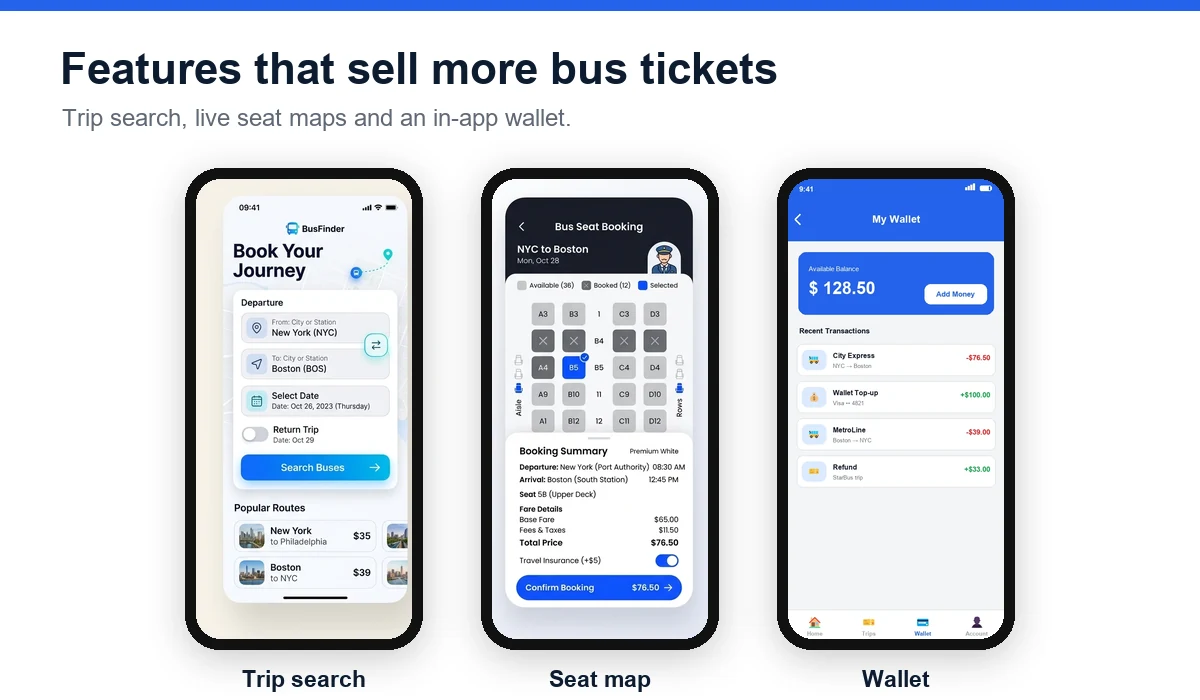
Real-time trip search
Passengers enter an origin, destination and date, and the system shows only trips that genuinely run and still have seats. Good search is fast, filters by time, price and operator, and never shows a sold-out or non-existent trip. This is the first thing a passenger touches, so it has to feel instant and accurate.
Live seat maps
A live seat map shows exactly which seats are free and lets the passenger choose their own, including upper or lower deck and sleeper layouts. Crucially, it locks a seat the instant it is reserved, so the same seat can never be sold twice, even when two people book at once. This single feature prevents the most common and damaging booking error in the industry.
QR e-tickets
The moment payment clears, the system issues a QR-coded e-ticket by email and SMS. At the boarding point the code is scanned to verify the passenger in seconds, with no paper list to search. This speeds up boarding and removes disputes about who paid for which seat.
Payments that fit every passenger
A booking is only as good as its checkout, and this is where many weak systems lose sales.
- Multiple gateways: Stripe, PayPal, local card processors and regional options, so passengers pay the way they trust.
- Multi-currency: cross-border passengers browse and pay in their own currency, with automatic conversion.
- Cash and bank options: pay-on-boarding or bank transfer where your market expects it.
- Automatic invoices and refunds: receipts generate instantly and refunds are handled cleanly from the dashboard.
- In-app wallet: passengers top up and pay faster on repeat trips, which encourages loyalty.
Routes, trips and boarding points
Behind the passenger view, the system has to model how your buses actually run.
| Feature | What it does |
|---|---|
| Route management | Define origins, destinations and stops for each service. |
| Trip scheduling | Set departure times and recurring schedules that generate trips automatically. |
| Boarding and dropping points | Offer multiple pickup and drop locations per route. |
| Seat layouts per bus | Configure standard, sleeper and double-deck layouts. |
| Fare rules | Set prices per route with seasonal or weekend variations. |
Accurate boarding points matter more than operators expect, because a confused pickup location is the fastest way to a bad review.
Operator and fleet management
If you run more than a couple of buses, or list other operators, you need tools to manage the fleet:
- Vehicle records with type, capacity, amenities and seat layout.
- Driver and trip assignment so each departure is linked to the right bus.
- Multi-operator dashboards, where each operator manages their own buses, trips and payouts.
- Commission control, so a marketplace owner sets rates and approves operators.
This is what lets a single site grow from your own fleet into a platform that earns from other operators' seats.
Offers, coupons and loyalty
Filling quiet departures is where margin is won or lost, so promotional tools earn their keep. Look for seasonal discounts, promo and coupon codes, early-bird pricing and wallet-based loyalty. Used well, these move passengers from empty mid-week trips to profitable full ones, and encourage booking directly on your site rather than through a commission-charging aggregator.
Automation: alerts and notifications
Automation is what lets a small team run a busy schedule. A good system sends, without anyone lifting a finger:
- E-tickets and payment receipts the moment a booking is paid.
- Departure reminders by email and SMS before the trip.
- Cancellation and refund notices when plans change.
- Review requests after the journey to build trust for future passengers.
Reports and insight
You cannot improve what you cannot see. Strong reporting turns raw bookings into decisions: revenue by route and period, seat occupancy, most and least popular departures, operator payouts and refund rates, all exportable to PDF and Excel. With this, you spot which routes to add, which schedules to trim, and where an offer would fill empty seats.
International and multi-vendor features
If you serve more than one country, or plan a marketplace, two feature sets matter:
- Multi-currency and multi-language, so cross-border passengers book in their own currency and language.
- Multi-operator marketplace, so other bus companies list on your platform while you earn a commission and control approvals.
Even if you do not need these on day one, choosing a platform that already has them means you never have to migrate later.
Trust, security and ownership
Passengers hand over money and personal details, so trust features are not optional. Look for secure, encrypted payments, SSL across the site, clear cancellation and refund rules, and genuine reviews and ratings. Just as important for you as the owner: the right to the full source code and your own data, so you are never locked into a closed system that holds your business hostage. Owning the platform means you control pricing, branding and expansion on your terms.
Feature checklist before you choose
Use this as a quick scorecard when comparing systems:
| Must-have | Nice-to-have |
|---|---|
| Live seat maps with real-time locking | In-app passenger wallet |
| Fast, accurate trip search | Loyalty and early-bird pricing |
| QR e-tickets by email and SMS | Multi-operator marketplace |
| Multiple payment gateways | Multi-currency and multi-language |
| Boarding-point management | Driver and trip assignment |
| Automated reminders and refunds | Advanced analytics and exports |
| Reports and payouts | Full source-code ownership |
Common questions
Which feature matters most?
Live seat maps with real-time locking. Everything else builds on the guarantee that a seat is sold only once; without it, you risk double bookings and angry passengers at boarding.
Do I need multi-operator features from the start?
Not necessarily. But choosing a platform that already includes them means you can grow from your own fleet into a marketplace without changing systems later.
Are these features expensive to get?
Not with a ready platform. X-Bus includes all of the core and most advanced features as configurable modules in a one-time package, rather than charging separately for each.
Seat selection: the feature passengers notice most
Of all the features, the one passengers mention most is being able to choose their own seat, so it deserves a closer look. A strong seat-selection feature shows a true-to-life layout of the actual bus, including the aisle, decks and any sleeper berths, with taken seats clearly marked and available ones easy to tap. It should reflect the real configuration of each vehicle, because a passenger who books a lower-deck window seat expects exactly that at boarding. Behind the scenes, the seat must lock the instant it is chosen and paid for, so two passengers can never end up with the same seat, even when they book seconds apart. Good seat selection also supports pricing by position, so premium seats can cost a little more, and it should work smoothly on a small phone screen where most bookings happen. Get this right and you remove the single biggest source of boarding disputes while giving passengers a reason to book directly with you rather than through a faceless aggregator that offers less control.
Mobile app vs website for bus booking
A common question is whether you need a mobile app, a website, or both. The honest answer is that a fast, mobile-friendly website is the essential foundation, because most passengers will first find you through a search or a shared link and book without installing anything. A responsive website that works perfectly on a phone captures that traffic and ranks in search results. A dedicated mobile app then adds value for your regulars: it keeps your brand on their home screen, enables push notifications for departures and offers, and makes repeat bookings a two-tap affair. The best approach for most operators is to launch with a strong mobile website and add an app once you have a base of loyal passengers worth bringing back. A capable platform supports both from the same system, so your routes, seats and payments stay in sync wherever the passenger books.
The admin dashboard: running the whole operation
The passenger-facing features get the attention, but the admin dashboard is where you actually run the business day to day, so its quality matters just as much. A good dashboard gives you a live view of every trip, how many seats are sold and how many remain, so you can see at a glance which departures need a promotional push. It lets you add or edit routes, schedules and fares without a developer, assign buses and drivers to trips, and handle cancellations and refunds in a few clicks. It shows payments as they arrive, generates invoices automatically, and calculates operator payouts if you run a marketplace. Role-based access means counter staff, operators and managers each see only what they should. The better the dashboard, the less time you spend wrestling with admin and the more you spend growing routes and filling seats.
Integrations that extend a bus ticketing system
A bus platform rarely works entirely alone, and the ability to connect it to other tools quietly saves hours. Useful integrations include SMS gateways for ticket delivery and reminders, email services for confirmations and marketing, and multiple payment providers so you can offer local methods alongside international cards. Maps and location services help passengers find boarding points. Accounting exports keep your bookkeeping clean, and analytics tools show where your traffic and bookings come from. Because a platform such as X-Bus ships with the full source code, you are never blocked from adding an integration you need later, which protects your investment as your business and the tools around it evolve.
How features work together on a real trip
Features matter most not in isolation but in how they combine on a single booking. A passenger searches a route, the real-time search returns a genuine trip, the live seat map lets them pick a window seat and locks it, the payment gateway takes their money in their own currency, and a QR e-ticket lands in their inbox and phone, all in under two minutes. Before departure, an automated SMS reminds them of the boarding point; at the roadside, a scan of the QR code confirms them in seconds; afterwards, a review request builds trust for the next passenger, and the sale appears in your reports and the operator's payout. Each feature is useful alone, but their value is in this seamless chain, which is exactly why a platform where they are built to work together beats a patchwork of separate tools.
X-Bus: every feature in one platform
X-Bus ships with all of the features in this guide as built-in, configurable modules: real-time trip search, live seat maps, QR e-ticketing, boarding-point management, operator and fleet tools, multiple payment gateways, multi-currency and multi-language, offers and coupons, automated alerts, reports and multi-operator marketplace support, all on Laravel with the full source code included. Packages start at $299 one-time, with Professional at $599 including installation and Enterprise at $1000 for large marketplaces, each with six months of support. See it working and request a demo on the X-Bus product page, and if you also sell hotels or tours, X-Booking adds those too.
In short
The features that define a good bus ticketing system are the ones that remove manual work and prevent mistakes: live seat maps, real-time search, flexible payments, QR e-tickets, boarding points, automation, reporting and the ability to grow into currencies, languages and other operators. Score any system against the checklist above, insist on owning the source code, and you will choose a platform you can build a lasting business on.