
It is easy to see that bus booking platforms sell tickets, but the money is more interesting than that. The same platform can earn in several ways at once, and understanding them helps you decide whether to run your own fleet, build a marketplace, or do both. This guide explains how bus booking platforms make money, which model fits which business, and how to combine them.
1. Direct ticket sales (the commission-free core)
The simplest and most important revenue is selling your own seats directly on software you own. When a passenger books on your own site instead of an aggregator, you keep the full fare rather than losing a double-digit commission on every ticket. On the thin margins of transport, that difference is often the gap between a profitable route and a break-even one.
This is why so many operators move online: the seats were always there, but selling them through your own platform means each one is worth more to you. Multiply that across every departure, every day, and owning the booking system pays for itself quickly.
2. Operator commissions (the marketplace model)
A marketplace earns a commission on other operators' seats without owning a single bus. You invite bus companies to list their routes and trips on your platform, and you take an agreed percentage or fixed fee on every booking they make through you. The operators get online reach and tools they did not have to build; you get a share of a volume far larger than your own fleet could produce.
This is how the largest regional booking sites scale. They started by selling their own or a few operators' seats, then grew into platforms earning a slice of thousands of trips a day. With the right software you control commission rates, approve operators, and manage payouts, all from one dashboard.
3. Convenience and service fees
Many platforms add a small, transparent service or convenience fee on top of the fare. Because passengers are paying for the convenience of booking online, choosing their seat and getting an instant e-ticket, a modest fee is widely accepted. Across high volume, these fees add up to a meaningful revenue line that is separate from the fare itself.
4. Seat and route upsells
Not every seat is equal, and passengers will pay for a better one. Common upsells include:
- Premium seats: front rows, extra legroom, or lower-deck and sleeper positions.
- Flexible fares: a higher price for free cancellation or changes.
- Add-ons: extra luggage, insurance, or onboard amenities where offered.
- Priority boarding on busy departures.
These upsells raise the average value of each booking without adding a single bus to your fleet, which is why they are among the most profitable features to switch on.
5. Promoted listings and featured operators
On a marketplace with many operators, visibility is valuable, so you can sell it. Operators pay to have their trips featured at the top of search results for a route, or highlighted during peak seasons. Done tastefully, this adds revenue while still showing passengers relevant options. It is the same model that powers large travel marketplaces, applied to bus routes.
6. In-app wallet float and repeat loyalty
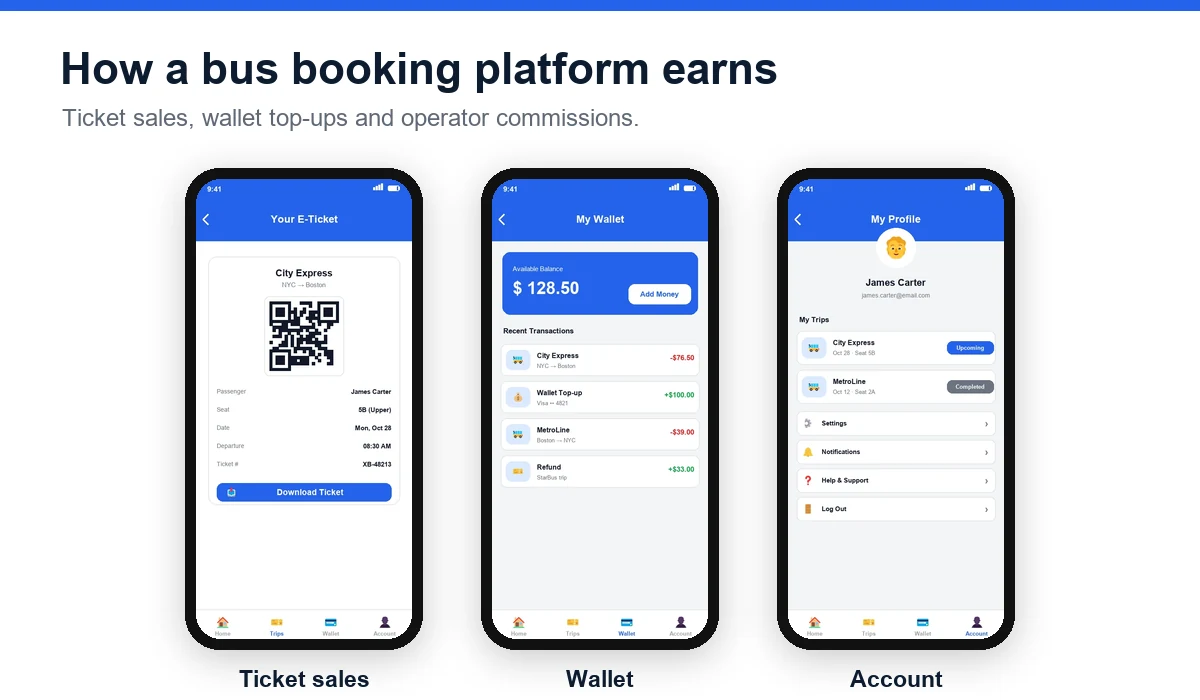
When passengers top up an in-app wallet to pay faster, that balance sits with the platform until it is spent. Beyond the modest float, the real value is loyalty: a passenger with wallet credit comes back to your site for their next trip rather than shopping around. Repeat direct bookings are the cheapest revenue you can earn, because you are not paying to acquire the customer again.
7. Data-driven offers that fill empty seats
This is less a separate stream than a multiplier on all the others. Because you own the booking data, you can see which departures run empty and send targeted offers to fill them. A mid-week trip at 30% occupancy earns far more at 70% with a small discount than it does running half empty at full price. Turning unsold seats into sold ones, using data you already have, is one of the clearest ways a platform lifts its own revenue over time.
Which model fits your business?
The right mix depends on what you are building.
| Business type | Primary revenue | Add-on revenue |
|---|---|---|
| Own-fleet operator | Direct ticket sales | Seat upsells, service fees, wallet loyalty |
| Ticketing agency | Margin or fee per seat | Service fees, upsells |
| Transport marketplace | Operator commissions | Promoted listings, service fees, upsells |
Most successful platforms combine several of these rather than relying on one. An own-fleet operator can also list a few partner operators; a marketplace can still run its own premium routes.
A simple revenue example
Imagine a route selling 100 seats a day at an average fare. Sold through an aggregator taking a 12% commission, you lose that slice on every seat. Sold directly on your own platform, you keep it. Add a small service fee and a handful of premium-seat upsells each day, and the direct channel earns noticeably more per departure. Now scale that across several routes and 365 days a year, and the picture is clear: the platform is not just a booking tool, it is a margin machine, and the margin grows as you shift sales from aggregators to your own site.
What you need to earn this way
All of these models depend on owning capable software rather than renting a listing. You need live seat maps and e-ticketing to sell directly, commission and payout tools to run a marketplace, upsell and fee options to lift average order value, a wallet for loyalty, and reports to see where the money is. A ready platform such as X-Bus includes all of these, so you can switch on whichever revenue models fit your business today and add more as you grow.
Common questions
Do I need buses to make money from a bus platform?
No. A marketplace earns commission on other operators' seats without owning any vehicles. You provide the software and reach; they provide the buses.
Are service fees worth adding?
Yes, when kept small and transparent. Passengers accept a modest convenience fee for booking online and choosing their seat, and across volume it becomes a steady revenue line.
How quickly can a platform become profitable?
For an own-fleet operator, the commission saved on direct sales often covers a one-time platform cost within the first busy season. A marketplace depends on the operators and volume you attract.
Why owning the platform beats renting a listing
It is worth pausing on why ownership sits at the heart of every revenue model here. When you rent a spot on an aggregator, you are a line in someone else's catalog: they set the commission, they own the passenger, and they can change the rules or your visibility whenever they choose. Your prices, your branding and even your access to your own sales data are limited by their platform. When you own the software, every one of those constraints disappears. You decide the fares, the fees, the offers and the look of every screen. You hold the passenger relationship, so you can market to past travellers directly and for free. You keep the full fare on direct sales instead of surrendering a slice of each one. And because a platform such as X-Bus comes with the full source code, you are never at the mercy of a provider who might raise prices or shut down. Ownership is not just a philosophical preference; it is the practical foundation that makes all the other ways of earning possible and keeps the margin firmly on your side.
Keeping costs low so more of the revenue is profit
Revenue is only half the story; what you keep after costs is what really matters, and a bus platform helps on that side too. The largest hidden cost for many operators is the commission paid to aggregators, which is exactly what owning your platform removes on direct sales. Beyond that, automation keeps your running costs low: automatic e-tickets, reminders and refunds mean you do not need a large counter team to handle bookings, and a single dashboard replaces several manual systems. Because a ready platform is a one-time purchase rather than monthly software rent, your ongoing software cost is mostly affordable hosting and per-transaction payment fees. The discipline is to let the software do the repetitive work, keep your fixed costs lean, and reinvest the saved commission into marketing that brings more direct bookings, which compounds your margin over time.
Earning across peaks and quiet periods
Bus travel is seasonal, with festivals, holidays and weekends bringing surges and mid-week periods running quiet, and a good platform helps you earn across both. During peaks, real-time seat maps and advance online sales let you fill buses that a counter alone could not, and peak pricing captures the extra demand without turning anyone away. During quiet periods, the same data shows you which departures are running empty so you can run targeted offers, early-bird deals or promo codes to fill seats that would otherwise travel empty. Over a full year, the operators who earn the most are not only the ones who do well at peak, but the ones who use their booking data to lift occupancy in the quiet weeks, because a seat sold at a small discount still earns far more than an empty one.
Turning first-time passengers into repeat bookers
Winning a passenger once is expensive; keeping them is cheap, and this is where a platform you own really pays off. Because you keep the passenger data, you can encourage the second booking in ways an aggregator never lets you. A saved profile and wallet make the next booking faster. A post-trip message thanking them and offering a small discount on their next journey brings them back. Email and SMS about new routes, schedule changes and seasonal offers reach people who already trust you, at almost no cost. A simple loyalty reward, such as credit after a number of trips, gives regulars a reason to choose you over a rival. Each repeat booking carries no acquisition cost, so it is pure margin, which is why the most profitable bus platforms focus as much on keeping passengers as on finding new ones.
Reinvesting your margin to grow
Once the platform is saving you commission and earning across several models, the smartest move is to reinvest part of that margin into growth rather than treating it all as profit on day one. A share spent on local marketing and SEO brings more direct bookings, which keep the full fare. A little spent on adding routes or boarding points opens new demand. Some set aside for occasional offers fills quiet departures. Because each new direct passenger then costs nothing to serve again, this reinvestment compounds: the margin funds growth, growth brings more margin, and the platform you own becomes the engine of a business that keeps expanding on its own terms.
Earn from every model with X-Bus
X-Bus supports every revenue model in this guide from one dashboard: commission-free direct ticket sales, operator commissions and payouts for a marketplace, service fees, seat and fare upsells, promoted listings, an in-app wallet and full reporting, all built on Laravel with the source code included. Packages start at $299 one-time, with Professional at $599 and Enterprise at $1000 for large marketplaces, each with six months of support. See how it works and request a demo on the X-Bus product page, and read our guide on how to start a bus booking business to put it into practice.
In short
Bus booking platforms make money through direct ticket sales, operator commissions, service fees, upsells, promoted listings and wallet-driven loyalty, usually several at once. The common thread is ownership: when you own the platform, you keep the margin that aggregators would take and you decide how to earn on top of it. Choose software that supports every model, and your platform grows from a booking tool into a genuine revenue engine.