
Every week, someone asks us the same question: "How do apps like Spotify actually work, and could I run one of my own?" The honest answer is that the streaming you see on screen is only the surface. Underneath sits a large piece of software that stores audio, decides what to recommend, takes payments and keeps artists paid. That software has a name, and this guide explains it in plain English.
What is music streaming platform software?
Music streaming platform software is a complete system for running an on-demand audio service. It is the engine behind a Spotify-style app: it holds your library of songs, albums, podcasts and radio stations, streams them to listeners on web and mobile, manages user accounts and subscriptions, and reports on what is being played and how much money it earns.
It replaces a dozen separate tools with one dashboard. Instead of stitching together a media server, a payment system, a mobile app and a spreadsheet of users, the platform gives you a single admin panel where everything lives together. And because it is software you own, you control the brand, the catalog, the prices and the rules rather than renting space on someone else's service.
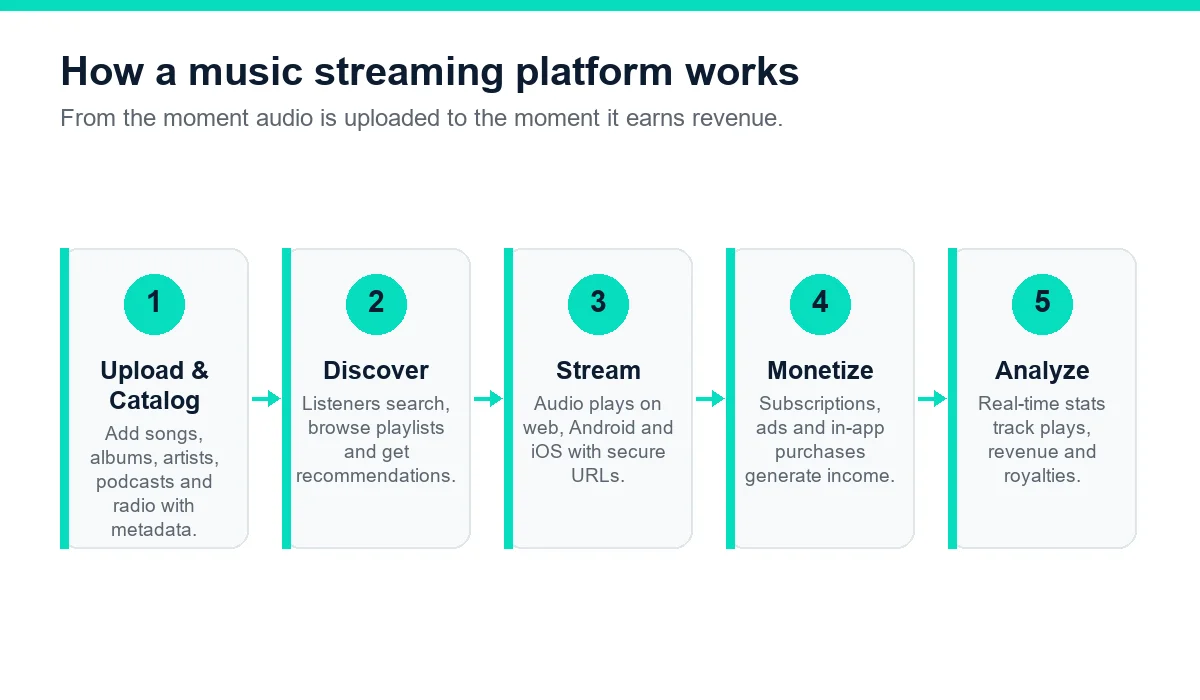
How music streaming software works, step by step
It helps to follow one song from the moment it is added to the moment it earns money. The path is always roughly the same, whatever the brand on the app.
- Upload and catalog. You add audio files along with their details, called metadata: title, artist, album, genre, cover art, lyrics and release date. Good metadata is what makes search, playlists and recommendations work later.
- Storage and delivery. Files are stored on a server or cloud bucket and served through secure, time-limited stream URLs so they cannot simply be copied. A content delivery network keeps playback fast for listeners in different countries.
- Discovery. Listeners open the app and find music by searching, browsing genres and moods, following playlists, or accepting recommendations the system generates from listening history.
- Playback. The chosen track streams to the listener's browser or phone. The player handles pause, skip, shuffle, queueing and, on paid plans, offline downloads.
- Monetization. Free listeners hear ads; paying subscribers get an ad-free, higher-quality experience. The platform charges cards automatically and records every transaction.
- Analytics and payouts. Every play is counted. Owners see which tracks and artists perform, how much revenue each plan brings in, and how much to pay creators in royalties.
The core modules you should expect
Serious music streaming platform software is built from modules, each handling one part of the business. When you evaluate any product, check that these are present and that you can actually manage them yourself.
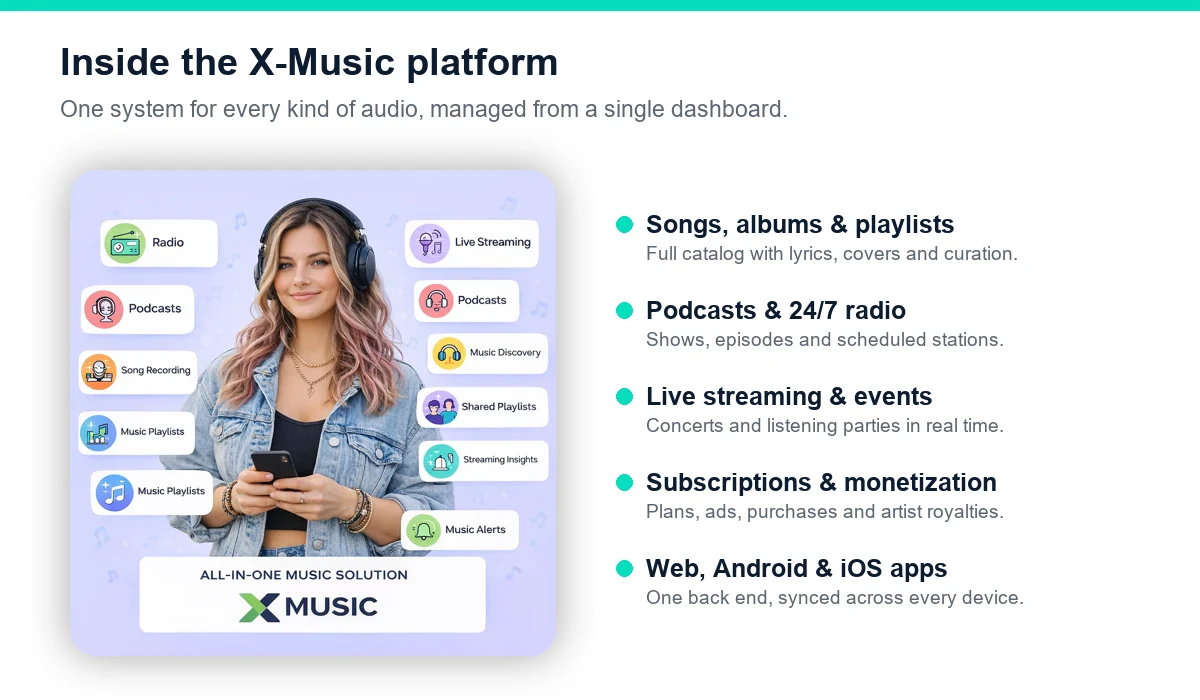
- Song and audio: tracks, albums, lyrics, cover art and quality settings.
- Artist and creator: profiles, uploads, verification badges and royalty payouts.
- Podcasts: shows, seasons, episodes and subscriber feeds.
- Radio: round-the-clock stations and scheduled broadcasts.
- Live streaming: concerts and events with real-time viewer engagement.
- Monetization: premium plans, advertising slots, in-app purchases and coupons.
- Subscribers and users: accounts, devices, listening history and billing.
- Catalog and library: genres, moods, curated and user playlists.
- System settings: roles and permissions, languages, payment gateways and branding.
This is exactly how X-Music, our own music streaming platform software, is organised: more than a dozen modules, all reachable from one smart dashboard.
Who uses music streaming platform software?
You do not have to be a technology giant to run a streaming service. The software is used by a wide range of businesses and creators:
- Streaming entrepreneurs launching a regional or niche competitor to the big apps.
- Record labels and studios that want their own branded home for their catalog.
- Independent artists and collectives selling direct to fans without a middleman.
- Podcast networks and radio stations moving their audience onto an app they control.
- Religious, educational and cultural organisations distributing audio to a specific community.
Key features to look for before you buy
Not all audio platforms are equal. Use this quick comparison of what a capable product should offer against what a basic script usually leaves out.
| Feature | Why it matters |
|---|---|
| Cross-platform apps | Reach listeners on web, Android and iOS, not just a website. |
| Secure streaming and DRM | Protects audio files from being copied and shared freely. |
| Multiple monetization options | Subscriptions, ads and purchases let you earn from every listener. |
| Real-time analytics | Shows plays, revenue and locations so you can make decisions. |
| Full source code ownership | Lets you customise, extend and scale without being locked in. |
| Role-based access | Lets a team work safely, each person seeing only what they should. |
Build from scratch or start with a ready platform?
This is the decision that saves or costs you the most. Building a streaming service from nothing means hiring developers, designing every screen, testing for months and fixing bugs no one has seen before. A ready platform gives you a proven codebase you brand and launch.
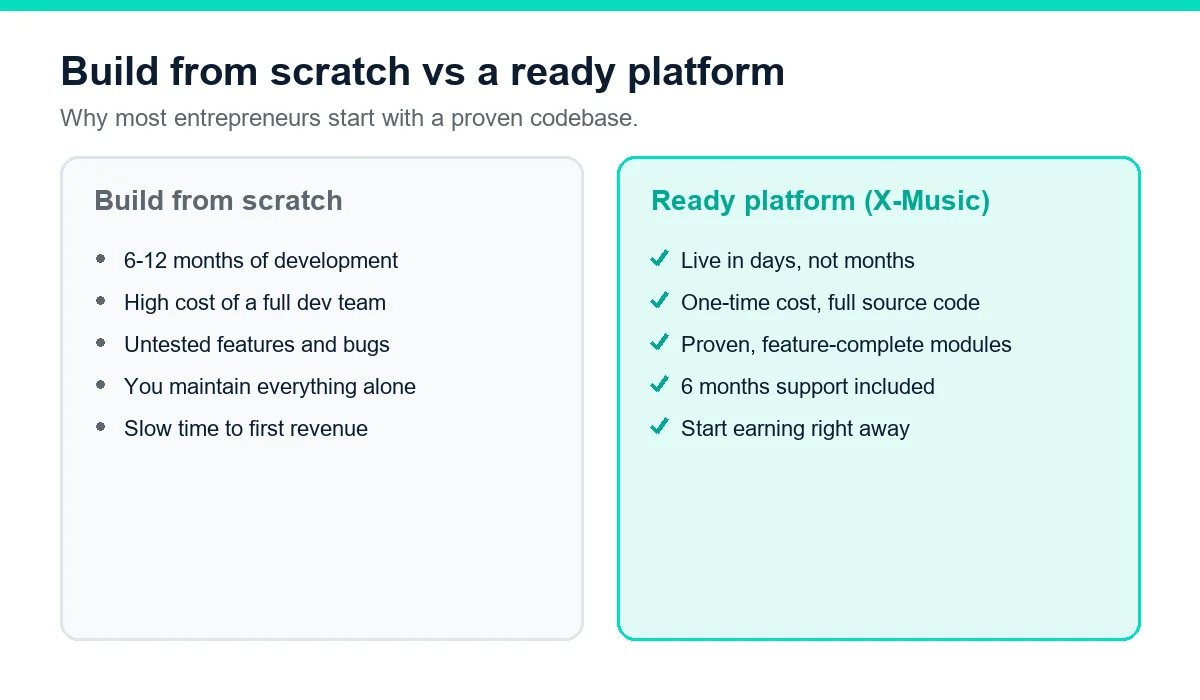
For almost everyone starting out, the ready route wins. It is faster, cheaper and less risky, and you still receive the full source code so nothing stops you customising it later. Our guide on how to start a music streaming service walks through the launch in detail.
The technology behind the scenes
You do not need to be an engineer to run the business, but it helps to know what powers it. Quality platforms such as X-Music are built on Laravel, a well-supported PHP framework trusted for secure, large web applications. Mobile apps for Android and iOS connect to the same back end through an API, so your catalog and subscribers stay in sync everywhere. Audio is protected with secure stream URLs and DRM configuration, and the whole system runs comfortably on a cloud VPS that you can scale up as your audience grows.
How the platform makes money
A streaming service is a business, not just an app, and the software is what collects the revenue. In short, free listeners generate advertising income, premium subscribers pay a monthly or yearly fee for an ad-free experience, and extras such as track downloads, live-event tickets and sponsored playlists add more. We cover each stream in depth in how music streaming platforms make money.
On-demand, radio, podcasts and live: four audio formats
People often lump all streaming together, but the software handles four distinct experiences, and a good platform does all of them well.
- On-demand streaming is the familiar Spotify experience: the listener chooses exactly what to play, when, and can pause, skip and repeat. It is the heart of most services.
- Radio is lean-back listening: continuous stations the listener tunes into rather than controls. It is ideal for discovery and for audiences who just want to press play.
- Podcasts are episodic shows with their own subscriptions and feeds. They attract a loyal, returning audience and are easy to monetize with sponsorships.
- Live streaming is real-time audio or video, such as concerts and listening parties, with chat and reactions. It creates moments fans will pay to attend.
Running these on four separate systems is painful. The value of complete music streaming platform software is that one back end, one subscriber list and one finance module cover all four.
Mistakes to avoid when choosing music streaming software
Having helped people launch these services, we see the same avoidable mistakes again and again:
- Buying a single-feature script. A cheap tool that only does on-demand playback leaves you rebuilding later when you want podcasts or live events.
- Ignoring the mobile apps. Most listening happens on phones. A web-only platform caps your audience from day one.
- Overlooking the finance module. If the software cannot track subscriptions, ads and royalties, you will drown in spreadsheets as you grow.
- Choosing software you cannot own. A rented, closed system limits your branding and locks in your data. Full source code keeps you in control.
- Skipping analytics. Without real-time data on plays and revenue, you are flying blind and cannot improve what you offer.
Is it legal to run your own streaming service?
Yes, running a streaming service is perfectly legal; the responsibility is to stream only music you have the right to. That means original content, music from artists who sign up directly, licensed catalogs, or royalty-free and public-domain libraries. The platform gives you the technology to stream and to pay royalties, but it does not grant music licences, so keeping clear records of who owns each track matters. Many successful niche services begin with independent artists and original content, then license more as they grow. If you are unsure about rights in your market, a short conversation with a music-licensing adviser is money well spent before launch.
Questions new owners ask us
Can one platform really handle thousands of listeners?
Yes. Built on Laravel and hosted on a scalable cloud VPS, the platform grows with your audience. You start on a modest server and upgrade resources as concurrent listeners rise, often adding a content delivery network to keep playback smooth across countries.
Do I need my own servers?
You need hosting, but not a server room. A cloud VPS gives you the performance a streaming service needs at a predictable monthly cost, and our team can set it up and secure it for you.
How do listeners find new music?
Through search, curated and personal playlists, genre and mood browsing, and recommendations the system builds from listening history. Strong metadata and a few well-made launch playlists make discovery feel effortless from the first visit.
Can I start small and grow?
Absolutely. Many owners launch with a focused catalog and a single premium plan, then add podcasts, radio, live events and more revenue streams once they have an engaged audience. The platform is built to expand with you.
X-Music: ready-made music streaming platform software
X-Music is an all-in-one, AI-assisted music streaming platform built on Laravel. It is a complete Spotify-style system covering songs, albums, artists, playlists, podcasts, radio and live streaming, with monetization and analytics built in, and it ships with the full source code so the platform is truly yours. It comes in three packages to match your stage of growth:
| Package | Price (one-time) | Best for |
|---|---|---|
| Basic | $299 | Getting started; includes an installation guide. |
| Professional | $599 | Growing services; full installation and server setup included. |
| Enterprise | $1000 | Large catalogs and offline playback, with full setup. |
Every plan includes six months of technical support, renewable afterwards. You can see the live feature breakdown and request a walkthrough on the X-Music product page.
Why now is a good time to launch
Three things have changed in favour of new services. First, the software is mature: ready platforms like X-Music are feature-complete, so you are not inventing anything. Second, hosting is cheap and scalable, so you only pay for the capacity you actually use. Third, audiences have grown comfortable paying for audio and following niche creators, which means a focused service with a clear identity can win loyal subscribers that the giant, one-size-fits-all apps overlook. The barriers that once kept this business out of reach have quietly fallen away.
Getting started is simpler than it looks
Running your own streaming service used to be the preserve of funded start-ups. Today the software is a one-time purchase, the hosting is affordable, and the launch is measured in days. If you have an audience, a catalog or a clear niche, music streaming platform software turns that into a real, revenue-earning product you own outright.
When you are ready, our team can install X-Music, brand it for you and help you take your first subscriber. Message us and we will recommend the package that fits your plans, not the most expensive one.