


For many US founders and small business owners, the biggest barrier to launching an app is cost. Agency quotes in New York, San Francisco or Austin can make a first version too expensive to test an idea. Hiring in-house developers is slow and costly too. An experienced offshore team can deliver the same quality for a fraction of the price, as long as you choose carefully and manage the project well. This guide explains how app development works for US businesses, what drives cost, which US rules apply, and how CodeX Link runs projects so you always know what is happening and what you are paying for.
iPhone first, Android too
The iPhone has a very large share of the US smartphone market, and iPhone users often spend more on apps and in-app purchases. That makes iOS essential for almost every US consumer app. Android still serves a large audience, especially in some demographics and regions. Cross-platform development with Flutter or React Native lets you launch on both at once without paying for two separate apps.
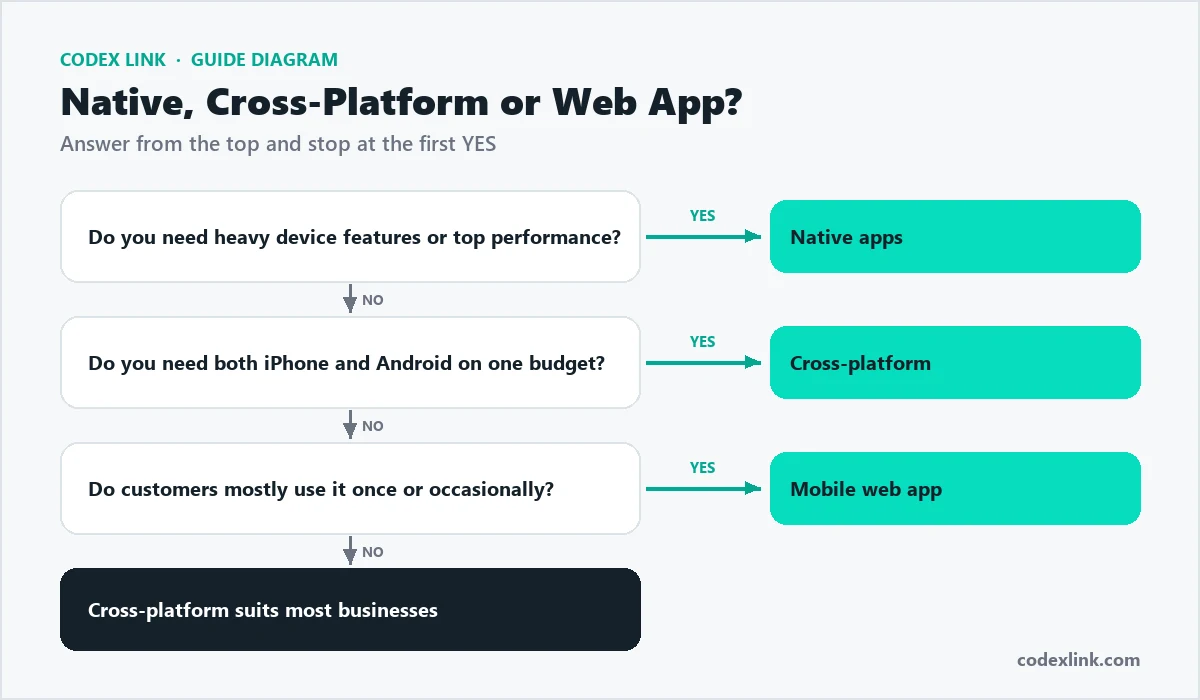
Tip: If your app relies heavily on Apple-specific features such as HealthKit, Apple Watch or advanced camera processing, consider native Swift for iOS. For most business and startup apps, cross-platform is the better value.
Is offshore app development right for you?
Offshore development works well when you have a clear idea, can give timely feedback and want professional quality at lower cost. It is less suitable if you need developers sitting in your office every day.
| Factor | US agency | Freelancer | CodeX Link |
|---|---|---|---|
| Cost | Highest | Low to medium | Low to medium |
| Team | Full team | Usually one person | Designer, developers, QA and project lead |
| Continuity | Good | Risky if they disappear | Company with ongoing support |
| Time zone | Same | Varies | Overlap with US mornings or evenings |
How we make offshore work smoothly
- Clear written scope with screens, features and acceptance criteria before work starts.
- Milestones with test builds you install through TestFlight and Google Play testing tracks.
- Weekly video calls at times that suit US time zones, plus written updates.
- Your accounts, your code: app store accounts, hosting and source code repositories are in your name.
Note: Pakistan is 9 to 10 hours ahead of New York and 12 to 13 hours ahead of Los Angeles, depending on daylight saving. Our evening overlaps with US mornings, and feedback you send at the end of your day is often worked on overnight.
US rules your app should respect
This is general guidance, not legal advice. Consult a US attorney for your specific situation.
COPPA: children's privacy
The Children's Online Privacy Protection Act (COPPA) applies to apps directed at children under 13, or apps that knowingly collect their personal information. It requires verifiable parental consent before collecting data from children. If your app is for kids or families, tell us at the start, because it affects design, analytics and advertising choices.
State privacy laws
California's Consumer Privacy Act, as amended by the CPRA, gives California residents rights over their personal information, and many other states, including Virginia, Colorado, Connecticut, Texas and others, have passed their own privacy laws. Thresholds and requirements differ by state. Apps should have a clear privacy policy, collect only necessary data and make it possible to handle access and deletion requests.
HIPAA: health data
Apps that handle protected health information for healthcare providers, health plans or their business associates must follow HIPAA. That affects hosting, encryption, access controls, logging and vendor agreements. Many consumer wellness apps are not covered by HIPAA but may still face FTC rules on health data.
Accessibility
Businesses face ADA-related claims over inaccessible digital services. We build apps with screen reader support (VoiceOver and TalkBack), dynamic text sizes, good contrast and clear labels.
App store rules
Apple and Google require privacy policies, accurate privacy labels, and account deletion inside apps that allow account creation.
App store fees and commissions
- Apple Developer Program: $99 per year.
- Google Play: one-time $25 registration fee.
- Commission on digital sales: Apple's Small Business Program and Google Play charge 15% for most developers on their first $1 million in yearly revenue from digital goods and subscriptions, and up to 30% above that.
- Physical goods and services, such as deliveries, bookings and rides, can usually use your own payment processor such as Stripe, without store commission.
How to choose an app development partner
Whether you hire us or someone else, ask these questions before you sign:
- Can you show apps you have built and explain your role in them?
- Who exactly will work on my project, and who is my main contact?
- Will I get a written scope, fixed price and milestone plan?
- Will the code, accounts and data be mine from day one?
- How do you test, and on which devices?
- What happens after launch, and what does support cost?
Clear, confident answers are a good sign. Vague answers about scope, ownership or testing are a warning.
Popular app types for US businesses
Startup MVPs
Founders use an MVP to test an idea with real users and raise funding. We focus on the core user journey, analytics and a clean architecture that can grow.
Service and booking apps
Salons, fitness studios, cleaners, tutors and clinics use apps for bookings, memberships and payments.
Restaurant and retail apps
Ordering, loyalty and rewards apps reduce dependence on third-party delivery platforms and their fees.
SaaS companion apps
Software companies add mobile apps to their web platforms so customers can work on the go. See our SaaS development service.
Field service apps
Contractors and service companies use apps for scheduling, job details, photos, signatures, invoices and GPS.
Marketplaces and community apps
Two-sided platforms connect buyers and sellers or providers and customers, with profiles, messaging, reviews and payments.

What does app development cost?
We give every client a fixed quote after a free consultation. For US clients, our prices are usually a fraction of typical US agency rates. The main cost drivers are:
- Scope: number of screens, features and user roles.
- Backend: APIs, database, admin dashboard and reporting.
- Integrations: Stripe, Apple Pay, maps, CRMs, calendars, AI features or existing systems.
- Compliance: HIPAA, COPPA or extra security requirements.
- Design: standard UI or a fully custom brand experience.
- Maintenance: hosting, monitoring, OS updates and new features.
| App size | Typical example | Typical timeline |
|---|---|---|
| Simple | MVP with core features, login and basic admin | About 4 to 8 weeks |
| Medium | Booking or ordering app with Stripe, notifications and dashboard | About 2 to 4 months |
| Complex | Marketplace, healthcare or multi-app platform | 4 months or more |
Fitness studio booking app (MVP)
Customer app:  sign up, class schedule, book and cancel,
               membership purchase with Stripe, reminders
Admin panel:   classes, instructors, members, payments, reports
Platforms:     iOS and Android (Flutter)
Phase 2:       referrals, in-app chat, Apple Watch integration
Our app development process
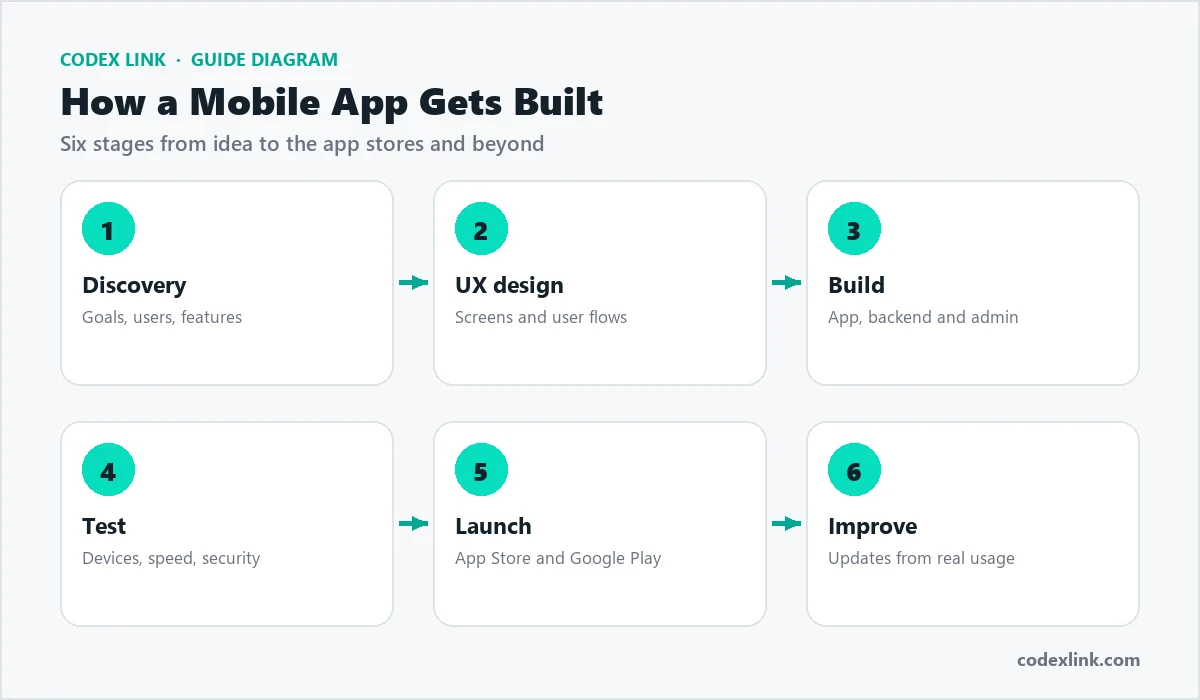
- Discovery: video call, scope document, fixed quote and milestone plan.
- UX design: clickable Figma prototype you can test with users or investors.
- Build: sprints with test builds and progress demos.
- Test: device testing, accessibility checks, security review and performance tuning.
- Launch: App Store and Google Play submission, privacy labels and store listings.
- Improve: analytics review, bug fixes and new features.
Technology we use
- Flutter and React Native for cross-platform apps.
- Swift and Kotlin for native features.
- Firebase for authentication, notifications, analytics and crash reports.
- Node.js and Laravel backends on AWS, Google Cloud or other hosting you choose.
- Stripe for payments, subscriptions and invoices.
Common mistakes when outsourcing an app
- Vague scope: leads to surprise costs. Insist on a written scope.
- Choosing only on price: the cheapest quote often means poor code that must be rebuilt.
- No access to code: always own your repository and accounts.
- Skipping testing: App Store rejections and bad reviews follow.
- No post-launch plan: apps need updates as iOS and Android change every year.
Running costs after launch
Budget for cloud hosting, push notification and email services, Stripe fees, the yearly Apple developer fee, monitoring tools and updates for each new iOS and Android release. We estimate these in your proposal so the first year is fully planned, not just the build.
Security from day one
US customers and investors expect strong security. We use encrypted connections and storage, secure authentication with options such as Sign in with Apple and Google, role-based access to admin tools, logging and regular dependency updates. Payment data is handled by Stripe or other certified processors rather than stored on your servers.
Contracts, IP and NDAs
Before we start, we can sign your NDA. Our agreement states that you own the intellectual property and source code you pay for, and all repositories and accounts are created in your name. That matters for fundraising, because investors want to know the company owns its technology.
Preparing for investors
If you plan to raise funding, your MVP should show real traction. We build in analytics from the start so you can track sign-ups, activation, retention and revenue, and we keep the codebase clean and documented so a future in-house team can take it over easily.
Metrics an MVP should track from launch
Sign-ups per week and where they came from
Activation: users who complete the key action
Retention: users still active after 7 and 30 days
Revenue: subscriptions, orders or bookings
Feedback: reviews, support requests, feature requests
App Store Optimization and launch
Getting approved is only the start. To be discovered, your listing needs a clear name and subtitle with relevant keywords, strong screenshots that show benefits, a short preview video where useful, and a description written for both people and search. After launch, ratings and reviews strongly influence downloads, so we add a polite in-app review prompt at the right moment, such as after a successful booking.
AI features in apps
Many US startups now add AI features, such as smart search, chat assistants, summaries, recommendations or image recognition. We integrate leading AI models through secure server-side APIs, so your keys and customer data stay protected, and we design fallbacks so the app still works if an AI service is slow. Start with one AI feature that clearly saves users time, then expand based on usage.
Note: If AI features process personal or health data, review your privacy policy and vendor agreements, and confirm how the AI provider stores and uses data.
Web app or mobile app first?
Some US startups do better launching a responsive web app first, especially B2B products used at a desk. Others need a mobile app from day one, such as on-demand, fitness or consumer social products. We help you choose based on where your users are and what they need to do, and we can share one backend between web and mobile apps, so you never build the same logic twice.
Testing before launch
Before submission, we test on a range of iPhones and Android phones, older and newer operating system versions, slow network conditions, accessibility settings such as larger text and VoiceOver, and payment flows in Stripe test mode. Careful testing avoids App Store rejections and protects your first reviews.
Why choose CodeX Link?
- Professional team of designers, developers and testers, not a single freelancer.
- Offshore pricing with fixed quotes and milestones.
- You own everything: code, accounts and data.
- Full product support: apps, web platforms, SaaS, hosting and SEO.
- Easy to reach on WhatsApp at +92 343 5673902 and by email at support@codexlink.com.
See our mobile app development service and our guide to website development in New York.