


In Dubai, customers order groceries, book beauty treatments, pay for parking, rent cars and manage property from their phones. Their standards are set by the best apps in the world, so a slow or confusing app damages a brand quickly. At the same time, many UAE agencies quote very high prices for app development. CodeX Link works online with UAE businesses, delivering professionally designed and engineered apps at a lower cost, with clear milestones and regular test builds. This guide explains how app development works in the UAE, what affects cost, which local features matter and how we take your app from idea to launch.
Why UAE businesses invest in apps
- Repeat customers: apps make reordering and rebooking effortless, which suits restaurants, salons, laundries, clinics and retailers.
- Loyalty: points, offers and personalised notifications keep customers coming back.
- Premium experience: a well-designed app signals quality, which matters in Dubai's premium markets.
- Operations: internal apps help drivers, technicians and sales teams work faster.
Tip: If customers use your service only once or twice, invest in a fast website first. See our guide to website development in Dubai.
iPhone and Android in the UAE
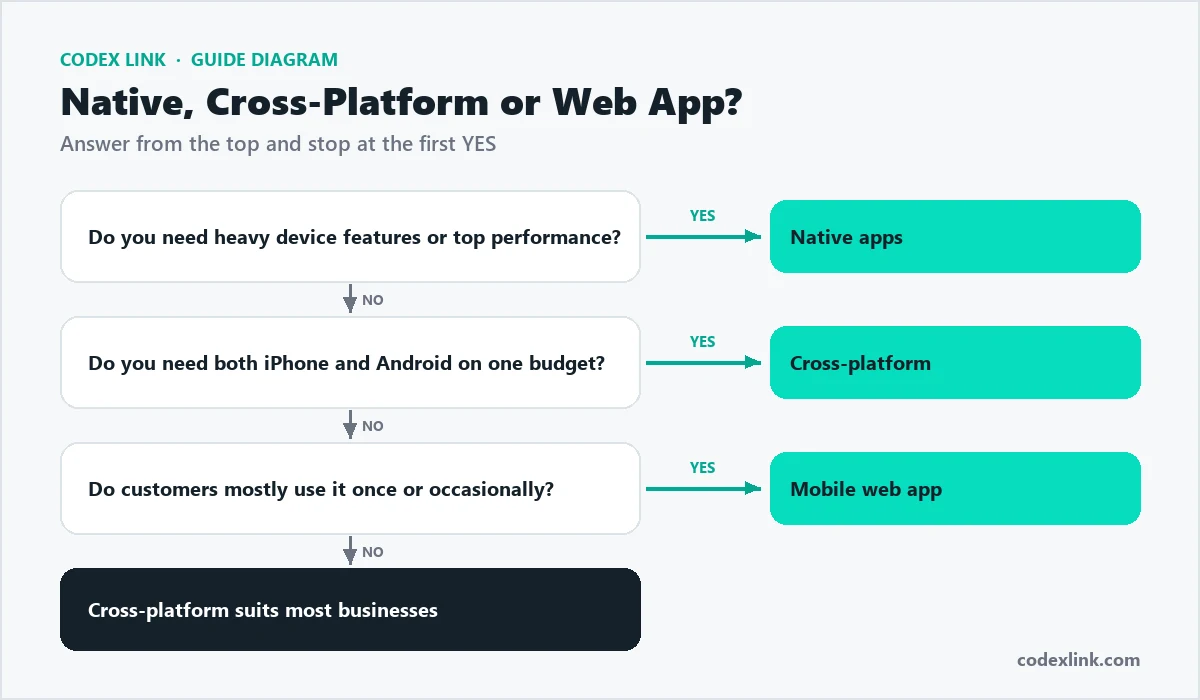
Unlike many markets where Android dominates, the UAE has a large share of iPhone users, especially among higher-spending customers. Android remains widely used too. Most UAE businesses therefore need both, built to the same quality. Cross-platform frameworks such as Flutter let us deliver both from one codebase while still respecting each platform's design conventions.
Arabic and English apps
Arabic is the official language of the UAE, while English is the everyday business language for its large international population. Consumer apps, and especially apps connected to government services or Emirati customers, should offer both.
A proper Arabic version means the whole interface mirrors to right-to-left: navigation, icons, back arrows, lists, forms and animations. Arabic fonts must be chosen for readability on small screens, and text often runs longer or shorter than English, so layouts must adapt. Flutter and native iOS and Android all support right-to-left layouts well when the app is planned for it from the start.
Language:   Arabic or English chosen on first launch,
            changeable later in Settings
Layout:     Mirrors fully in Arabic (menus, icons, arrows)
Content:    Product names, notifications and emails in both languages
Store:      Separate Arabic and English App Store listings
Payments in UAE apps
- Apple Pay and Google Pay: extremely popular in the UAE and often the fastest checkout.
- Cards: Visa and Mastercard through UAE gateways such as Network International, Telr or Checkout.com, or through Stripe where available.
- Buy now, pay later: Tabby and Tamara are widely used for retail and services.
- Cash on delivery: still used for some e-commerce orders.
Prices in the UAE generally include 5% VAT, so apps should show VAT-inclusive prices and issue correct tax invoices. Ask your accountant how VAT applies to your business.
Note: Digital goods and subscriptions sold inside an app usually must use Apple and Google in-app purchases. Physical goods and real-world services can use your own payment gateway.
UAE rules apps should respect
This is general guidance, not legal advice. Confirm details with a UAE legal adviser.
UAE Personal Data Protection Law
Federal Decree-Law No. 45 of 2021 on the Protection of Personal Data (PDPL) sets rules for processing personal data in the UAE. Apps should explain clearly what data they collect, ask for consent where needed, collect only what is necessary, keep data secure and let users exercise their rights. Businesses in the DIFC and ADGM free zones follow their own separate data protection laws.
Health, finance and regulated sectors
Healthcare, financial and other regulated apps may have extra requirements from the relevant authorities, such as rules on where data is stored. Tell us early if your app handles health records, payments or financial data.
App store requirements
Apple and Google both require a privacy policy, accurate privacy and data safety labels, and an in-app way to delete an account when users can create one.
UAE Pass and government integrations
UAE Pass is the national digital identity used to access many government and private services. Some apps, particularly those connected to government services, real estate or regulated sectors, can benefit from UAE Pass login or document signing, subject to approval from the relevant authorities. If your app works with government processes, we can advise on what integrations may be possible.
Popular app types in Dubai
Food, grocery and delivery
Restaurants and stores use their own apps alongside delivery platforms to reduce commission costs and build direct relationships with loyal customers.
Beauty, wellness and fitness
Salons, spas, clinics and gyms use apps for bookings, memberships, packages and reminders.
Real estate and property management
Developers, brokers and property managers use apps for listings, viewings, maintenance requests, rent reminders and tenant communication.
Car rental and services
Rental companies, car washes and garages use apps for bookings, document upload, pick-up and drop-off.
Tourism and events
Tour operators and event companies use apps for tickets, schedules, maps and live updates.
Field service and logistics
Maintenance, cleaning and logistics companies use staff apps for job assignment, GPS, photos, signatures and reports.

How much does app development cost in the UAE?
App costs in Dubai vary widely, and many local agencies charge premium rates. CodeX Link works online, which lets us offer much lower prices for the same professional standards. We give a fixed quote after a free consultation. The main cost drivers are:
- Features and screens: the scope of the first version.
- User roles: customers, staff, drivers and administrators.
- Languages: Arabic and English with right-to-left layouts.
- Integrations: payment gateways, Tabby or Tamara, maps, CRM, ERP or booking systems.
- Design: standard or fully custom premium design and animation.
- Backend and admin: dashboards, reports and management tools.
- Maintenance: hosting, updates and support after launch.
| App size | Typical example | Typical timeline |
|---|---|---|
| Simple | Brand, catalogue or booking request app | About 4 to 8 weeks |
| Medium | Ordering or booking app with Apple Pay, admin panel and Arabic | About 2 to 4 months |
| Complex | Marketplace, delivery or multi-app platform | 4 months or more |
Tip: Launch an MVP with the features customers need most, then add loyalty, referrals and advanced features in later phases.
Our app development process
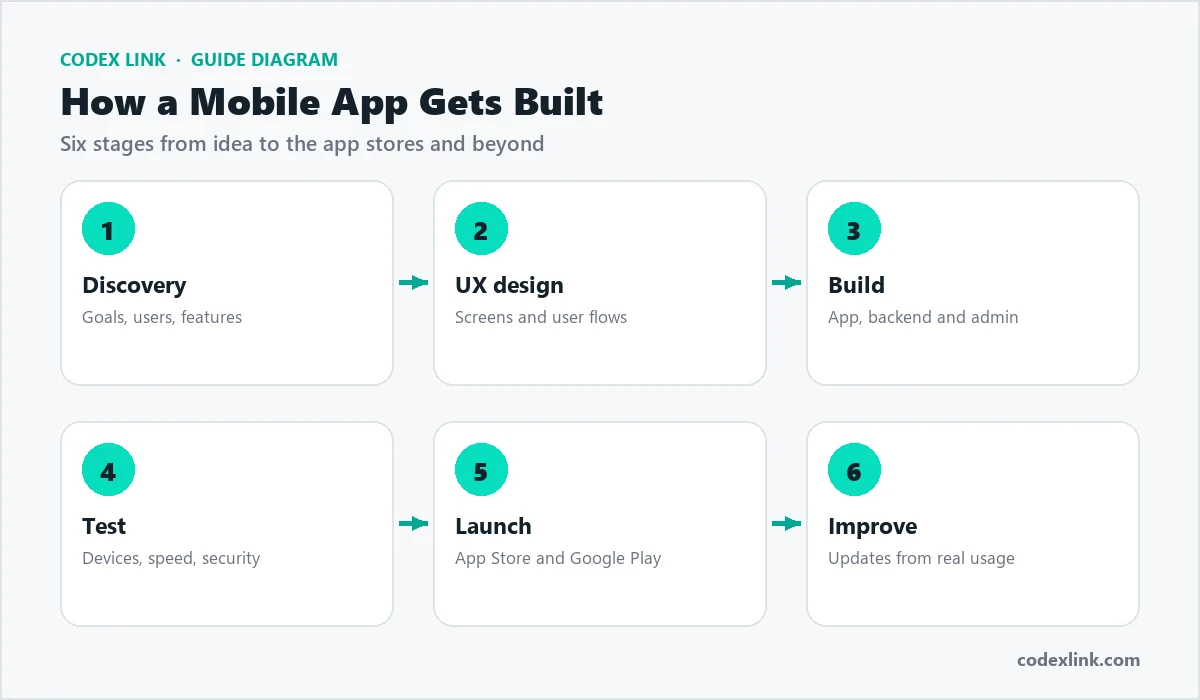
- Discovery: a video call to understand your business, customers and goals, then a written scope and quote.
- UX design: clickable designs in Figma for both Arabic and English.
- Build: development in milestones, with test builds through TestFlight and Google Play testing tracks.
- Test: testing on many devices, in both languages, plus performance and security checks.
- Launch: store listings in Arabic and English, privacy labels and submission.
- Improve: analytics, updates and new features.
Pakistan is one hour ahead of the UAE, so our working hours almost completely overlap with yours, including the UAE's Monday to Friday working week.
Technology we use
- Flutter and React Native for cross-platform apps.
- Swift and Kotlin for native features and maximum performance.
- Firebase for authentication, notifications, analytics and crash reporting.
- Laravel and Node.js for backends and admin panels.
- Cloud hosting with regional options where data location matters.
Marketing your app in the UAE
- App Store Optimisation in Arabic and English.
- Instagram, TikTok and Snapchat campaigns with deep links into the app.
- Launch offers and referral rewards.
- Your website with clear download buttons and app landing pages.
- Reviews: prompt satisfied users for ratings at the right moment.
Common app mistakes in the UAE
- English only: missing Arabic-speaking customers.
- Poor Arabic layout: text that is translated but not mirrored.
- Slow checkout: no Apple Pay or too many steps.
- Ignoring data protection: unclear consent and privacy information.
- Overbuilding version one: long, expensive projects before any customer feedback.
Security and hosting
UAE customers expect their data to be handled carefully. We use encrypted connections, secure authentication, role-based admin access, regular backups and payment processing through certified gateways rather than storing card data ourselves. Where data location matters, for example in healthcare or government-related projects, we can use cloud regions in the Middle East. Tell us early about any sector rules that apply.
Running costs after launch
Plan for backend hosting, push notifications, SMS or email services, payment gateway fees, the yearly Apple developer fee and updates for new iOS and Android versions each year. We list expected running costs in your proposal, so your budget covers the full first year, not just development.
Who owns the app?
You do. Your app store accounts, source code, hosting and data are all in your name. We can continue maintaining the app, but you are never locked in.
Working with a remote team
Many UAE businesses already work with teams in other countries. We make remote collaboration simple with a written scope, a shared project board, weekly video calls in UAE hours, quick WhatsApp updates and test builds you can install on your phone at every milestone. You see progress as it happens rather than waiting months for a big reveal.
Salon booking app: milestone plan
Milestone 1:  Designs approved in Arabic and English
Milestone 2:  Booking flow working in test build
Milestone 3:  Apple Pay, Tabby and admin panel complete
Milestone 4:  Testing, store submission and launch
Questions to ask any app developer in the UAE
- Can you show apps you have built, including Arabic apps?
- Will I receive a written scope, fixed quote and milestones?
- Will I own the source code, store accounts and data?
- How will you handle UAE data protection and privacy labels?
- Which payment gateways and instalment providers have you integrated?
- What does support cost after launch?
We answer every question in writing before you commit.
Loyalty and retention features
For many Dubai businesses, the real value of an app is repeat business. Loyalty points, tiered rewards, birthday offers, referral codes and personalised push notifications keep customers returning without paying platform commissions each time. We design these features around your margins, so rewards encourage loyalty without eroding profit.
Cafe loyalty in an app
Earn:      1 point per AED 1 spent
Reward:    free drink at 200 points
Bonus:     double points on weekday mornings
Referral:  friend's first order gives both a free pastry
Apps for the wider GCC
Many UAE businesses expand to Saudi Arabia, Qatar, Oman, Bahrain and Kuwait. If regional growth is in your plans, we design the app to support several countries from the start: multiple currencies, country-specific VAT, local payment methods such as mada in Saudi Arabia, delivery zones and content for each market. Planning for expansion early costs far less than rebuilding later.
Tip: Keep country settings, such as currencies, tax rates and payment methods, in the admin panel, so your team can launch new markets without new app releases.
Testing in real UAE conditions
Before launch, we test the app in both languages on a range of iPhones and Android phones, check Apple Pay and card payments in test mode, confirm that addresses, maps and delivery zones work for areas such as Dubai Marina, Deira, Al Barsha and Abu Dhabi, and make sure push notifications arrive in the language each user chose.
Why choose CodeX Link?
- Professional apps at lower cost than typical Dubai agency rates.
- Arabic and English apps with proper right-to-left design.
- Fixed quotes and milestones, with test builds throughout.
- One team for apps, websites, backends, hosting and SEO.
- Support on WhatsApp at +92 343 5673902 and by email at support@codexlink.com.
See our mobile app development and custom software services, and our guide to website development in Riyadh for Saudi Arabia.