


Pakistan has one of the largest mobile internet audiences in the world, and people use their phones for almost everything: ordering food, booking rides, paying bills with JazzCash or Easypaisa, shopping and learning. For many businesses, an app is the next step after a website. It keeps your brand on the customer's home screen, lets you send notifications, and makes repeat orders and bookings much easier. This guide explains how app development works in Pakistan, what affects the cost, which technology to choose, and how CodeX Link takes an app from idea to Google Play and the App Store.
Do you need an app or a website?
Not every business needs an app. A fast, mobile-friendly website is enough when customers visit you occasionally. An app makes sense when customers come back often, or when you need phone features such as notifications, location, camera or offline use.
| Choose a website when | Choose an app when |
|---|---|
| Customers visit once or occasionally | Customers order, book or log in every week |
| You mainly need to be found on Google | You want push notifications and loyalty |
| Budget is limited | You need GPS, camera, scanning or offline use |
| Content changes often and must be searchable | You run a delivery, booking or on-demand service |
Tip: Many successful businesses start with a website and add an app once they have regular customers. If you do not have a website yet, see our website development guide for Islamabad and Rawalpindi.
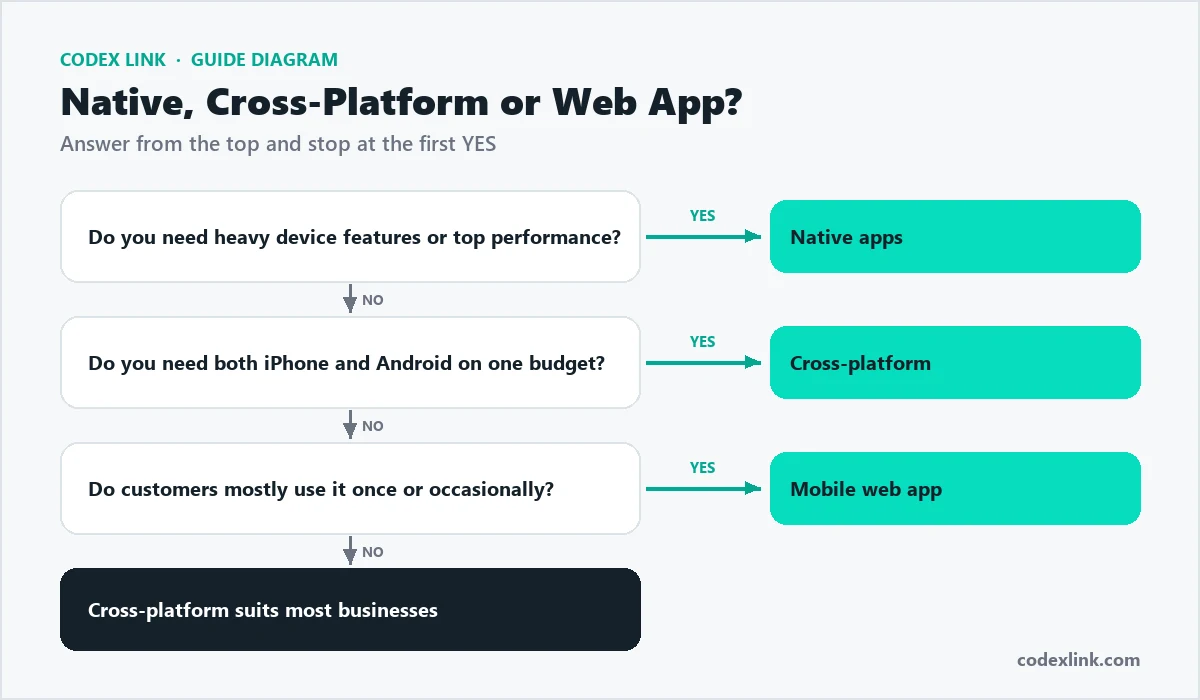
Android, iPhone or both?
The large majority of smartphones in Pakistan run Android, from budget models to flagship phones. That makes Android the priority for most consumer apps. However, many professionals, business owners and overseas Pakistanis in the Gulf, UK and North America use iPhones. If your customers include any of these groups, you need iOS too.
Cross-platform development solves this. With Flutter or React Native, we write the app once and publish it to both Google Play and the App Store. This usually costs far less than building two separate native apps, and updates reach both platforms together.
Note: Publishing requires developer accounts in your business's name. Google Play charges a one-time registration fee of $25, and the Apple Developer Program costs $99 per year. We help you set up both.
Building apps for Pakistani users
Budget phones and slow networks
Many users have phones with limited storage and memory, and mobile internet can be slow or patchy, especially outside big cities. We keep app size small, compress images, cache data so key screens work offline or on weak connections, and test on lower-end Android phones, not only on new flagships.
Urdu and English
Apps aimed at the general public often need Urdu as well as English. Urdu is written right to left in the Nastaliq style, so layouts and fonts must be adjusted carefully. Roman Urdu in notifications and messages can also feel more natural for many users.
Payments: JazzCash, Easypaisa and more
Card ownership is lower than in many countries, so local payment options matter:
- JazzCash and Easypaisa mobile wallets, used by millions of people.
- Bank cards through local payment gateways.
- Raast, the State Bank of Pakistan's instant payment system, for bank transfers.
- Cash on delivery, still important for e-commerce and delivery apps.
Login with phone number
Most Pakistani users prefer to sign up with a mobile number and a one-time SMS code rather than an email and password. Phone login reduces drop-off at sign-up.
WhatsApp integration
WhatsApp is the main communication app in Pakistan. Order confirmations, support chats and sharing links through WhatsApp make apps feel familiar and trustworthy.
Popular types of apps we build
Delivery and e-commerce apps
Restaurants, grocery stores, pharmacies and retailers use apps for repeat orders, with product catalogues, carts, multiple payment options, order tracking and a rider app for deliveries.
Booking apps
Clinics, salons, gyms, tutors and service businesses use booking apps with calendars, reminders and payments.
Education apps
Academies and schools use apps for recorded lectures, live classes, quizzes, attendance and parent updates. Pakistan has a large demand for exam preparation apps.
Real estate apps
Developers and agents use apps to show projects, availability, payment plans and instalment tracking.
Business and field-team apps
Distributors, sales teams and service companies use internal apps for orders, attendance, GPS tracking, inventory and reports.
On-demand service apps
Ride, home service and repair platforms connect customers with providers, with live location, ratings and in-app payments.

What does an app include?
Customers only see the app, but most business apps have three parts:
1. Mobile app      What customers install (Android and iOS)
2. Backend / API   Server that stores users, orders and data securely
3. Admin panel     Web dashboard where your team manages products,
                   orders, users, notifications and reports
A delivery business may also need a fourth part: a separate rider or staff app. Each part adds work, so we define all of them clearly in the proposal.
How much does app development cost in Pakistan?
App prices vary more than website prices, because apps vary so much. Instead of a fixed package, CodeX Link gives every client a fixed quote after a free consultation. The main things that affect the cost are:
- Number of screens and features: a simple catalogue app is far smaller than a marketplace with buyers, sellers and riders.
- User roles: customer only, or customer, staff, rider and admin.
- Backend and admin panel: how much your team needs to manage.
- Integrations: payments, SMS, maps, couriers, accounting or existing software.
- Design: a clean standard design or a fully custom brand experience.
- Platforms: Android only, or Android and iOS.
- Maintenance: updates for new phone operating systems, hosting and support after launch.
| App size | Typical example | Typical timeline |
|---|---|---|
| Simple | Business catalogue, information or booking request app | About 4 to 8 weeks |
| Medium | Online store or booking app with payments and admin panel | About 2 to 4 months |
| Complex | Marketplace, delivery platform or on-demand service with several apps | 4 months or more |
Tip: Start with a Minimum Viable Product (MVP): the smallest version that solves the main problem for customers. Launch it, learn from real users, and add features in later phases. This keeps the first budget manageable.
Our app development process
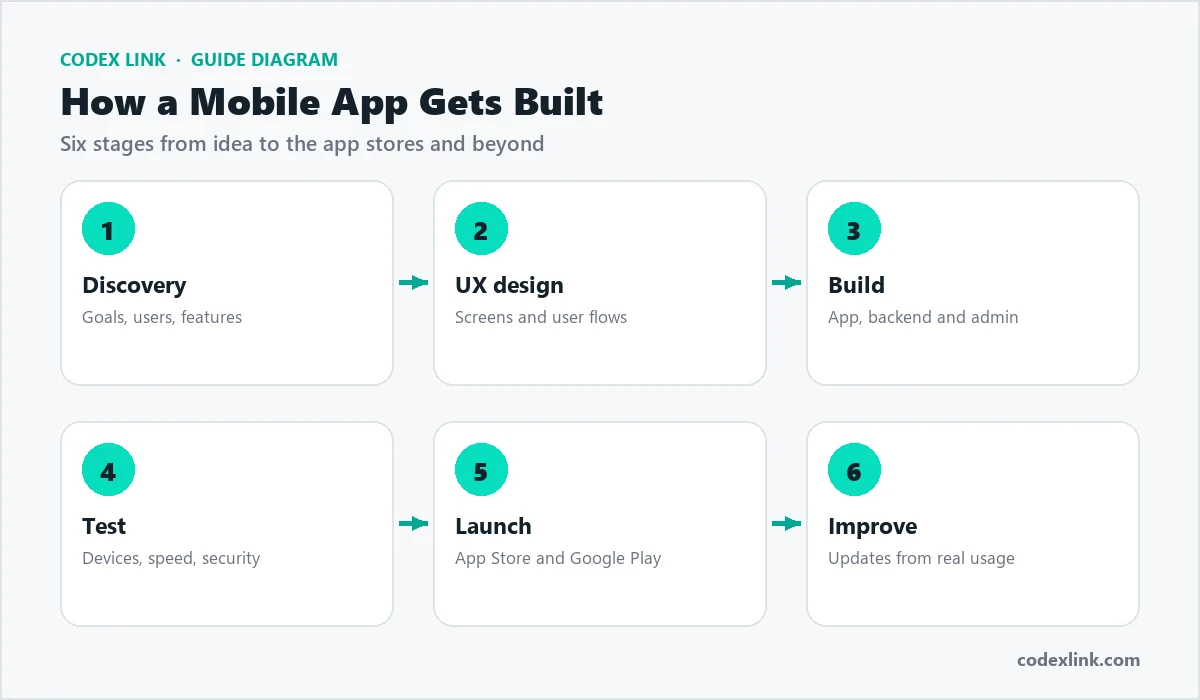
- Discovery: we discuss your idea, customers, competitors and must-have features, then agree the MVP.
- UX design: wireframes and screen designs in Figma, so you can see and click through the app before coding starts.
- Build: development of the app, backend and admin panel in milestones, with regular test builds you can install on your phone.
- Test: testing on different phones, screen sizes and network speeds, plus security checks.
- Launch: we prepare store listings, screenshots and privacy details, and submit to Google Play and the App Store.
- Improve: bug fixes, updates and new features based on real usage and reviews.
Technology we use
- Flutter: Google's framework for fast, attractive cross-platform apps from one codebase.
- React Native: a popular framework based on JavaScript and React.
- Kotlin and Swift: native Android and iOS languages, for apps that need maximum performance or deep device features.
- Firebase: authentication, push notifications, analytics and crash reports.
- Laravel and Node.js: secure backends and admin panels, hosted on fast servers.
App store approval
Google and Apple review apps before publishing them. Apple's review is usually stricter. Common reasons for rejection include crashes, missing privacy policies, unclear account deletion options, incomplete information and features that do not work in the review. We prepare your app to meet store guidelines, including a privacy policy, data safety details for Google Play and an in-app option to delete accounts where required.
Note: If you sell digital content or subscriptions inside the app, Apple and Google usually require their in-app payment systems and take a commission. Physical goods and real-world services, such as food delivery or salon bookings, can normally use your own payment gateway.
Marketing your app after launch
- App Store Optimisation: clear app names, keywords, screenshots and descriptions in English and Urdu.
- Website and social media: promote the app on your website, Instagram, Facebook and TikTok, with download links.
- Launch offers: discounts or free delivery for the first app order.
- Reviews: ask happy users for ratings, and reply to reviews.
- Push notifications: useful, not spammy, messages about orders, offers and reminders.
Common app mistakes in Pakistan
- Building everything at once: large first versions that take too long and cost too much.
- Testing only on expensive phones: the app feels slow for most real users.
- No local payments: customers cannot pay the way they prefer.
- Email-only sign-up: users abandon registration.
- No plan after launch: apps need updates, hosting and marketing to succeed.
Security and data protection
Apps often store phone numbers, addresses, order histories and payment references, so security matters from day one. We use encrypted connections, secure login with one-time codes, role-based access in admin panels, regular backups and careful handling of payment data through approved gateways rather than storing card details ourselves. Pakistan's proposed personal data protection law is still developing, but building good privacy practices now protects your customers and prepares you for future rules and for app store requirements.
Hosting and running costs
An app is not a one-time cost. Plan for server hosting, SMS charges for login codes, push notification services, payment gateway fees, the yearly Apple developer fee and updates for new Android and iOS versions. We explain expected running costs in the proposal, so there are no surprises after launch.
Monthly running costs to plan for
Server hosting for the backend and admin panel
SMS one-time codes for login
Payment gateway transaction fees
Apple Developer Program (yearly)
Maintenance and small improvements
Who owns the app?
You do. The Google Play and App Store accounts are registered in your business's name, and you receive the source code and admin access. This protects your investment and means you are never locked in.
Questions to ask any app developer in Pakistan
- Can you show apps you have published on Google Play or the App Store?
- Will I get a written scope, fixed price and milestone plan?
- Will the source code and store accounts be in my name?
- Which phones will you test on, including budget Android phones?
- How will JazzCash, Easypaisa or card payments be integrated?
- What support and updates do you provide after launch?
Clear answers to these questions protect your budget. We answer all of them in writing before any payment.
Tip: Pay in milestones linked to working test builds, not large amounts up front. It keeps every project accountable.
Apps for overseas Pakistanis
Many Pakistani businesses serve customers abroad, such as overseas Pakistanis sending gifts, groceries or payments home, booking property visits or paying school fees for family. These apps need iPhone support, international card payments, prices shown clearly in rupees and the customer's currency, and delivery tracking that family members in Pakistan can follow.
Why choose CodeX Link?
- A real office in Westridge, Rawalpindi, serving Islamabad, Rawalpindi and clients across Pakistan online.
- One team for apps, websites, backends, hosting and SEO.
- Fixed quotes and milestones, agreed in writing, with test builds throughout the project.
- Local know-how: JazzCash and Easypaisa payments, Urdu interfaces, phone login and low-bandwidth performance.
- Support on WhatsApp at +92 343 5673902 and by email at support@codexlink.com.
See our mobile app development, custom software and SaaS development services.