

Canada welcomes hundreds of thousands of newcomers every year, and LinkedIn is one of the first tools many of them use to find work. It is also central to hiring and B2B sales in Toronto, Vancouver, Montreal, Calgary and Ottawa. This guide explains what LinkedIn Premium costs in Canadian dollars, how taxes work, which plan suits you and how to use LinkedIn to land a job or clients in Canada.
LinkedIn Premium price in Canada at a glance
| Plan | US list price (monthly) | Approx. CAD* | CodeX Link price | Approx. CAD* |
|---|---|---|---|---|
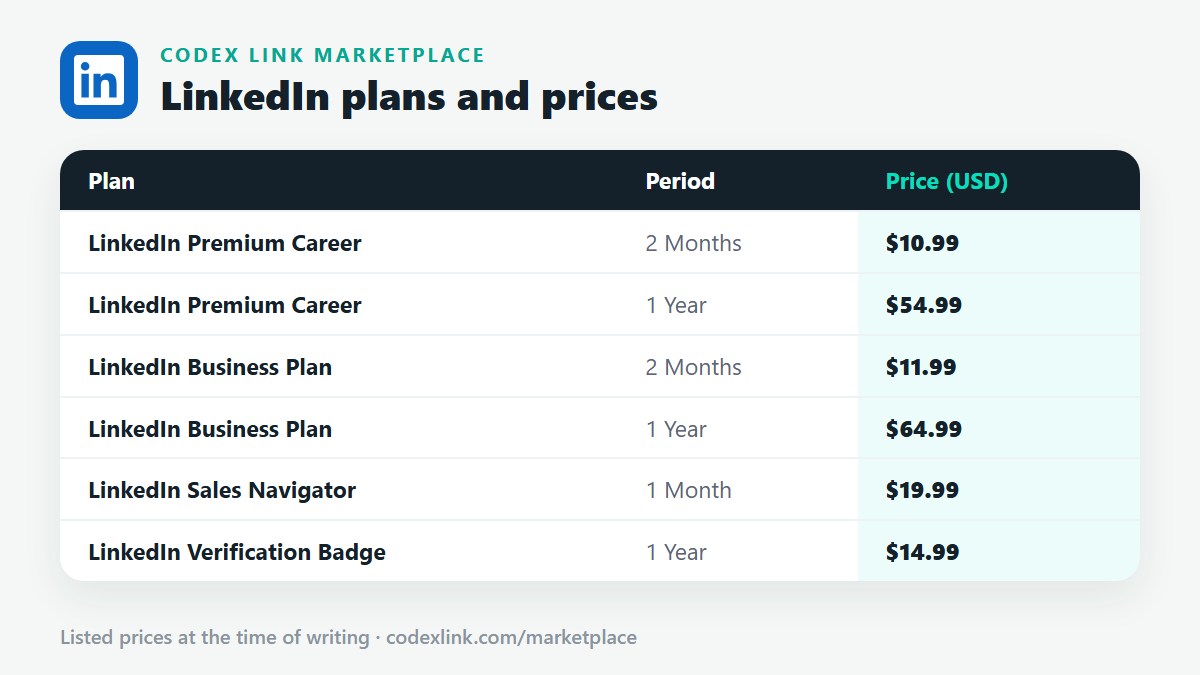
| Premium Career | about $29.99 | about 41 / month | $10.99 / 2 months $54.99 / 1 year | about 15 about 76 |
| Premium Business | about $59.99 | about 83 / month | $11.99 / 2 months $64.99 / 1 year | about 17 about 90 |
| Sales Navigator Core | about $99.99 | about 138 / month | $19.99 / 1 month | about 28 |
*At an example rate of 1.38 CAD per USD, before tax. LinkedIn usually charges Canadian members in CAD at its own local price, which may differ from a direct conversion; annual billing usually lowers the monthly cost. LinkedIn shows the final price, including GST or HST, at checkout.
GST and HST on LinkedIn Premium
Canada applies sales tax to many digital services sold to Canadian residents, including subscriptions from foreign companies. Depending on your province, you may see GST, HST, or GST plus a provincial tax such as QST in Quebec. LinkedIn calculates tax from your billing address and shows it at checkout.
Which plan is right for you?
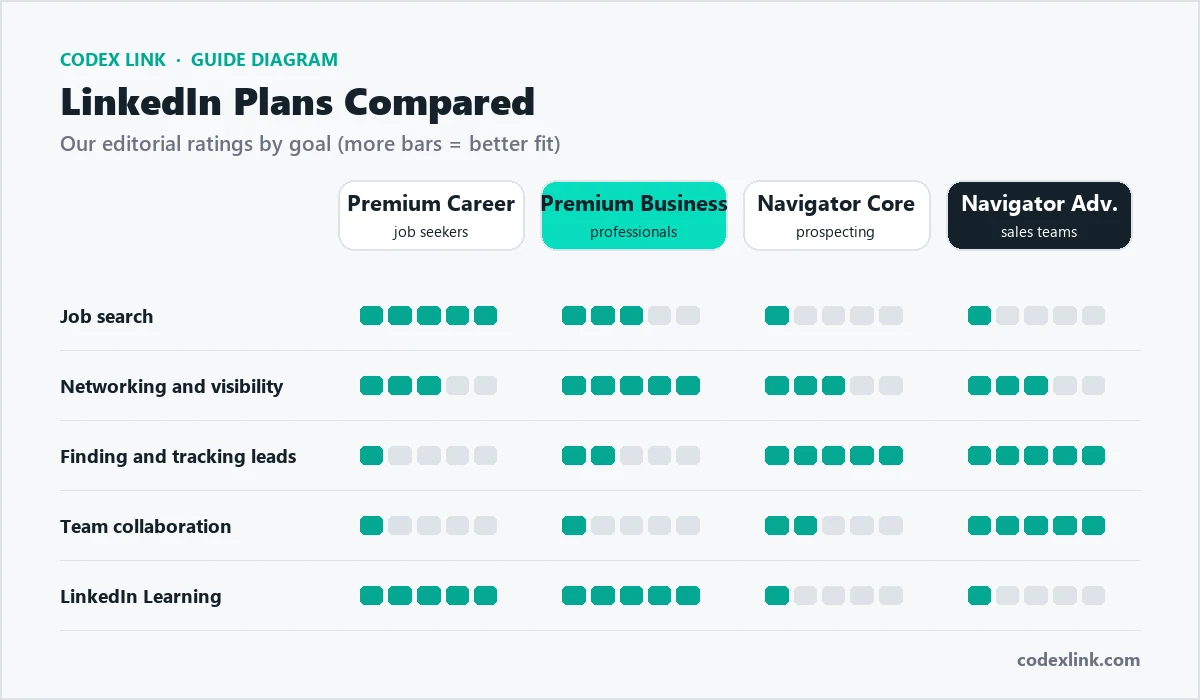
- Premium Career: for job seekers and newcomers. InMail, who viewed your profile, applicant insights and LinkedIn Learning. See our Premium Career guide.
- Premium Business: for professionals, consultants and owners who network and research companies. See our Premium Business guide.
- Sales Navigator: for B2B prospecting across Canada and the US. See our Sales Navigator guide.
LinkedIn for newcomers to Canada
Newcomers often hear that they need "Canadian experience". LinkedIn helps bridge that gap by showing your skills clearly, building a Canadian network and connecting you with people who can refer you.
- Start before you land: update your location to your destination city when appropriate and connect with professionals there.
- Translate your experience into Canadian job titles and explain international companies briefly.
- Show credentials: mention credential assessments, Canadian certifications and licensing progress for regulated professions.
- Request informational interviews: short conversations with people in your field are a common and accepted way to network in Canada.
- Use InMail to reach hiring managers after applying.
An informational interview request:
Hi Emily, I recently moved to Toronto from Dubai, where I worked
for 6 years as a supply chain analyst. I noticed you lead the
planning team at Northern Foods. Could I ask you three quick
questions about the industry here over a 15-minute call? I would
really appreciate your perspective.
A newcomer profile set up for Canadian recruiters:
Headline:  Financial Analyst | IFRS, Excel, Power BI |
           CPA Canada candidate | Open to roles in Toronto
Location:  Toronto, Ontario
About:     Line 1: specialism and years of experience
           Line 2: key results at international employers
           Line 3: Canadian credential progress and work status
Featured:  Portfolio of financial models, certificates
Volunteer: Treasurer, local newcomer association
Regulated professions
Engineers, nurses, doctors, teachers, accountants and some trades need a licence or certification from a provincial regulator to practise in Canada. On LinkedIn, list where you are in the licensing process, for example "EIT" or "licence in progress", and connect with professionals who completed the same path. Recruiters search for these terms, and clarity saves time for both sides.
Bilingual profiles: English and French
Canada is officially bilingual, and French is essential in Quebec and valuable for federal government and national roles. LinkedIn lets you add a second profile language, so you can create a French version of your profile. If you speak French, list your level clearly; bilingual candidates are in demand for many roles.
Co-op students and new graduates
Many Canadian universities and colleges run co-op programmes that combine study with paid work terms. Students should list each co-op term as experience, ask supervisors for recommendations and connect with co-op employers on LinkedIn. Graduates can use the Alumni tool on their school's page to find former students at target employers, who are often happy to offer advice and referrals.
Working remotely from Canada for US companies
Canada's time zones match the US, and many Canadians work remotely for US employers, either as employees through an employer of record or as independent contractors. On LinkedIn, filter for remote roles that accept Canadian candidates, mention your province and time zone, and be clear about your work arrangement preferences. Understand the tax implications of contracting before you accept.
Networking events and meetups
Canadian cities have active professional communities, from technology meetups in Toronto and Vancouver to industry associations and newcomer networking events across the country. Use LinkedIn to see who is attending, connect with people on the same day you meet them, and follow up with a short note referencing your conversation. In-person relationships turned into LinkedIn connections are some of the strongest you will build.
Key Canadian job markets
- Toronto: finance, technology, consulting and head offices.
- Vancouver: technology, film and media, trade and clean energy.
- Montreal: AI research, aerospace, gaming and bilingual roles.
- Calgary and Edmonton: energy, engineering and growing technology sectors.
- Ottawa: federal government and technology.
Selling in Canada with Sales Navigator
Canadian B2B buyers are reachable through Sales Navigator by province, city, industry and company size, and many Canadian companies also operate in the US. Build separate lead lists for Canada and the US, because buying processes, regulations and messaging can differ.
A lead search for an HR software provider:
Geography:     Ontario, British Columbia, Alberta
Function:      Human Resources
Seniority:     Manager, Director, VP
Company size:  51-200, 201-500
Industry:      Construction, Manufacturing, Retail
How to get Premium through CodeX Link
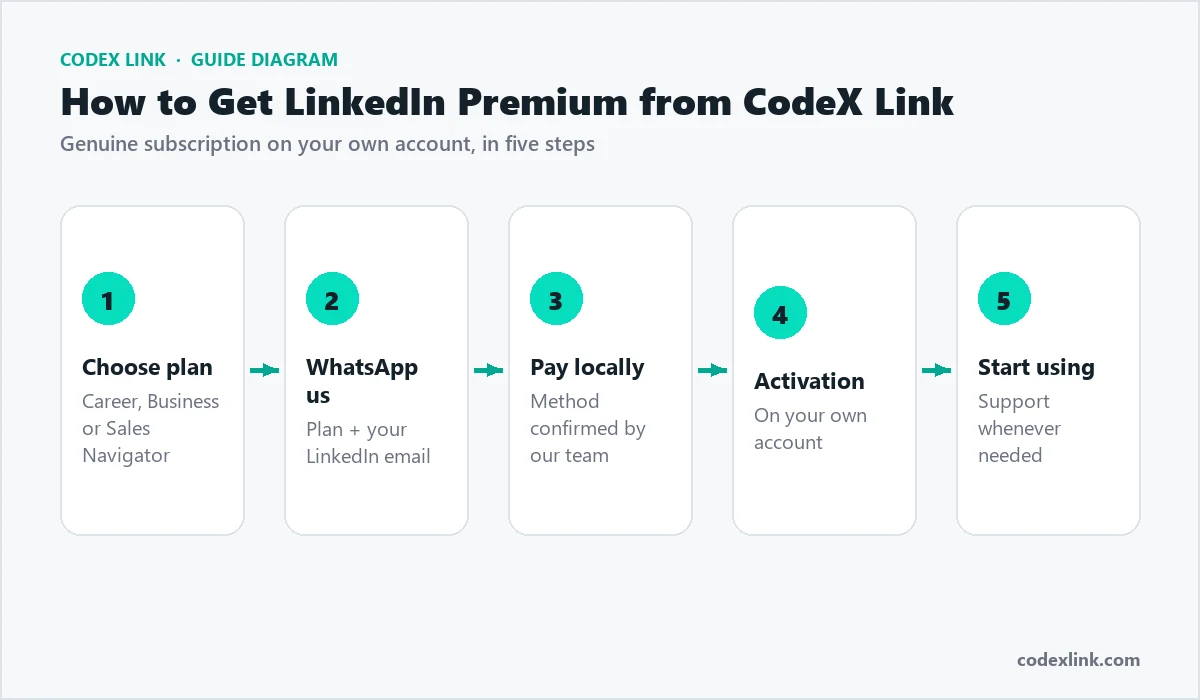
- Choose your plan on the CodeX Link marketplace.
- Message our team on WhatsApp with the plan and your LinkedIn account email.
- Pay with a method our team confirms.
- The subscription is activated on your own account.
- Start using Premium, with support whenever you need it.
Verification in Canada
In Canada, LinkedIn identity verification has been handled by CLEAR. You confirm your phone number, scan a Canadian passport or driving licence and take a selfie. Newcomers without Canadian documents yet may be able to verify later, once they have them. Verified profiles help recruiters trust that you are who you say you are. See our verification by country guide.

Getting the most from Premium in Canada
- Use InMail for informational interviews as well as job applications.
- Check who viewed your profile and reconnect with interested recruiters.
- Complete Canadian-relevant LinkedIn Learning courses, such as Canadian workplace communication or project management.
- Join industry and newcomer groups and contribute helpful comments.
- Ask for recommendations from Canadian volunteer supervisors and contacts.
Avoiding job-offer scams
Newcomers are sometimes targeted by fake recruiters. Be cautious of anyone who asks you to pay for a job offer, a work permit, an "LMIA" or training before you start work; legitimate employers do not charge candidates to be hired. Verify recruiters' profiles and company pages, check job postings on the company's official careers site, and report suspicious accounts to LinkedIn.
Negotiating your offer
Canadian employers expect some negotiation, especially for professional roles. Several provinces have introduced or announced pay transparency rules, which can give you useful salary data in job postings. Research typical ranges for your role and city, consider the full package, including benefits, vacation and RRSP matching, and respond to offers politely with a clear, researched counter-proposal.
Free trial and cancellation
Eligible members can usually try Premium free for a month. The trial renews automatically unless you cancel under Settings, then Subscriptions and payments. You keep features until the end of the paid or trial period. See our Premium discounts and free trial guide.
Premium features glossary
- InMail: messages to people outside your network.
- Who viewed your profile: a fuller list of profile visitors.
- Applicant insights: how you compare with other applicants.
- Open Profile: lets anyone message you for free.
- LinkedIn Learning: the course library included with Premium.
Building Canadian references
Canadian employers often check references before making an offer, and newcomers may not have Canadian referees yet. Volunteer roles, bridging programmes, short contracts and professional association activities are good ways to build local references quickly. Add these experiences to LinkedIn, ask supervisors for written recommendations on your profile, and keep in touch with them so they are ready to speak for you when an employer calls.
Using LinkedIn Learning for Canadian workplace skills
Premium includes LinkedIn Learning, which is useful for newcomers adapting to Canadian workplaces. Courses on workplace communication, interviewing, Excel, project management and industry-specific software help you prepare for interviews and the first months in a new job. Add certificates to your profile as you finish each course, and mention what you learned in a short post to show recruiters you are actively building skills.
Time management for your search
A focused weekly routine works better than applying at random. For example: two days of targeted applications, one day of informational interviews and networking, one day of learning, and regular check-ins on who viewed your profile. Track your activity and results in a simple spreadsheet so you can see what is working and adjust quickly.
Common mistakes
- Listing only international job titles that Canadian recruiters do not search for.
- Not mentioning work authorisation or credential status when it matters.
- Applying to hundreds of roles without networking.
- Ignoring French when targeting Quebec or federal roles.
- Buying shared accounts from unofficial sellers.
Is LinkedIn Premium worth it in Canada?
For newcomers and active job seekers, Premium Career can be worth it during the first months of a search, when direct access to recruiters and hiring managers and visibility into profile viewers make a real difference. For consultants, owners and sales professionals, Premium Business or Sales Navigator pays off when used every week. If you are settled and not searching, the free plan with a strong profile is enough.
Tracking your progress
Keep a simple weekly record of applications, InMails, informational interviews, replies and interviews. If recruiters view your profile but do not reply, improve your headline and About section; if you get interviews but no offers, practise answers to Canadian behavioural questions, which often follow the STAR format of situation, task, action and result. Small weekly improvements add up quickly over a two-month Premium plan.
Stay patient and positive. Remember that persistence matters in Canada's job market. Many newcomers find their first role through a contact made months earlier, so keep networking, learning and following up even when results feel slow; consistent effort on LinkedIn compounds over time.
How CodeX Link can help
Get genuine Premium Career from $10.99, Premium Business from $11.99 and Sales Navigator for $19.99, activated on your own account, from the CodeX Link marketplace. Also see LinkedIn Premium in the USA and our LinkedIn roadmap.