
Starting a music streaming service sounds like something only a Silicon Valley team can do. It is not. The technology that once cost millions is now a one-time software purchase, and the hard parts are the ones no code can solve: choosing a niche, securing a catalog and reaching listeners. This guide takes you through the whole journey in order, so nothing important is missed.
Step 1: Choose your niche and audience
The services that succeed are specific. Competing head-on with Spotify on its own ground is hard, but there is room everywhere else: a language or region the big apps underserve, a single genre, faith-based audio, a podcast network, a label's own catalog, or a creator with a loyal following. Decide who your listener is before you decide anything technical. A clear audience shapes your catalog, your pricing and your marketing.
Step 2: Sort out your catalog and rights
Streaming music you do not have the rights to is the fastest way to be shut down. Make sure every track in your catalog is music you own, have licensed, or have permission to stream. Many new services start with original content, independent artists who sign up directly, podcasts, or public-domain and royalty-free libraries, then grow from there. Keep clear records of who owns what, because you will use them to pay royalties later.
Step 3: Decide to build or buy
Here is where many projects stall. Building a streaming platform from scratch means designing every screen, writing the player, the payment system and the mobile apps, then testing for months. For most founders that is too slow and too expensive. A ready platform gives you a proven, feature-complete system you brand and launch, with the source code included so you can still customise it.
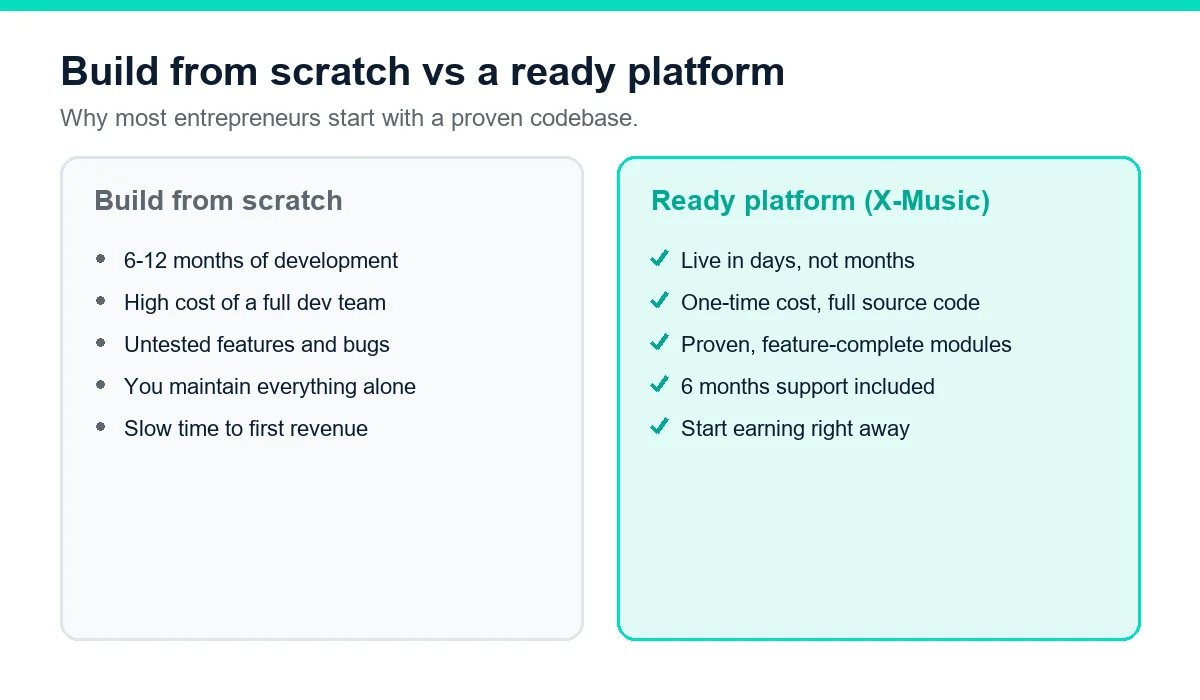
Our X-Music platform is built exactly for this: a complete, Laravel-based streaming system covering songs, podcasts, radio and live events, ready to brand and deploy.
Step 4: Get hosting and a domain
Your service needs a home. That means two things:
- A domain name that is short, memorable and matches your brand. Register it in your own name so you always control it.
- Reliable hosting. Streaming is demanding, so a cloud VPS with fast storage is the usual starting point. You can scale up as your audience grows, and add a content delivery network so playback stays fast worldwide.
If servers are not your area, our team sets up and secures the hosting for you as part of installation.
Step 5: Install, brand and configure the platform
With hosting ready, the platform is installed and made yours. This is where it stops being generic software and starts being your service.
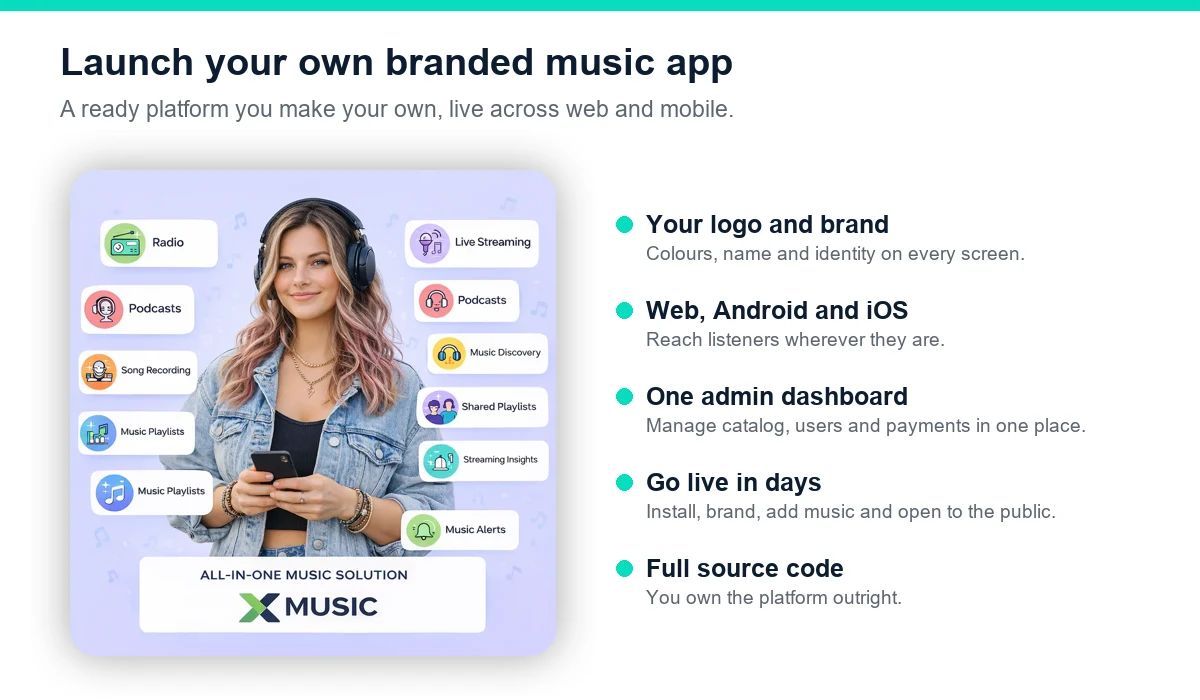
- Add your logo, colours and app name so the web and mobile apps carry your identity.
- Set your languages and currency for the audience you chose in step one.
- Create user roles so any team members see only what they need.
- Configure genres, moods and playlists that fit your catalog.
Step 6: Upload your music and content
Now fill the library. Upload songs, albums, podcasts and radio content, each with complete metadata: titles, artists, cover art, genres and lyrics. Good metadata is what makes search and recommendations work, so it is worth doing carefully. Build a handful of strong playlists to greet new listeners, because an empty-looking app loses people in seconds.
Step 7: Connect payments and set your plans
To earn money you need to take it. Connect a payment gateway, then design simple plans:
- A free tier supported by ads, to bring people in.
- One or two premium plans, monthly and yearly, for ad-free, higher-quality listening and offline downloads.
Keep it simple at launch. You can add more plans, trials and coupons once you understand what your audience values.
Step 8: Test everything before you open the doors
Before announcing your service, run through it as a real listener would. Create an account, play tracks on web and phone, subscribe with a test card, cancel, and check that confirmation emails arrive. Fixing problems now, while no one is watching, is far better than losing your first real subscribers to a broken checkout.
Step 9: Launch and start marketing
Opening the app is the start, not the finish. Tell the audience you identified in step one, through the channels they already use: social media, a mailing list, your artists' own followings, WhatsApp groups and local press. Encourage early subscribers with a launch offer, and ask every happy listener to share. Streaming is a word-of-mouth business, and your first hundred fans bring the next thousand.
Step 10: Measure, improve and monetize further
Once people are listening, the analytics module becomes your compass. Watch which tracks and playlists perform, where listeners drop off, and which plan converts best. Then expand your income carefully with live events, track purchases and sponsored playlists. Our guide to how music streaming platforms make money covers every option.
A realistic 30-day launch timeline
With a ready platform, a focused owner can go from idea to open in about a month. Here is a timeline that works in practice:
- Week 1 — Foundations. Lock in your niche, confirm your catalog and rights, register your domain, and choose your package.
- Week 2 — Setup. Hosting is prepared, the platform is installed and branded with your logo and colours, and payment plans are drafted.
- Week 3 — Content. Upload songs, podcasts and radio with full metadata, build launch playlists, and connect the payment gateway.
- Week 4 — Test and launch. Invite a small group to try the service, fix what confuses them, then open to the public with a launch offer.
Preparation is what keeps this on schedule. The more your catalog and branding are ready before setup begins, the faster the whole launch moves.
Do you need a mobile app?
In almost every case, yes. The majority of listening happens on phones, and audiences expect to find your service in the app stores, not just on a website. A web-only player caps your reach from the start. This is why X-Music includes Android and iOS apps that connect to the same back end as the web player, so your catalog, subscribers and payments stay in sync wherever people listen. Having apps also makes your service feel established and trustworthy, which helps conversion.
How much can you earn?
Earnings depend on your audience size and how well you convert free listeners into paying ones, but the model scales cleanly. Even a modest, loyal audience can sustain a small business when you combine recurring subscriptions with advertising on the free tier and occasional purchases or live events. Because subscriptions renew automatically, revenue compounds: the subscribers you win this month keep paying while you add more. Our guide to how music streaming platforms make money breaks down every stream and how the finance module collects them.
Common mistakes when launching a streaming service
- Launching with an empty-looking library. A handful of strong playlists and complete catalog details make a new service feel alive. A sparse app loses visitors in seconds.
- Trying to beat Spotify at its own game. Win a specific niche instead. Focus beats scale when you are starting out.
- Over-complicating pricing. Start with one free tier and one premium plan. Too many options confuse people and reduce sign-ups.
- Neglecting marketing. The app is only half the job. Plan how you will reach your first hundred listeners before you launch, not after.
- Forgetting the rights. Stream only music you are allowed to. This protects the business you are building.
What it costs to start
Your real budget is smaller than most people expect. The main items are the platform licence, hosting, a domain and your marketing. With X-Music, the platform is a one-time purchase in three packages:
| Package | Price (one-time) | What it suits |
|---|---|---|
| Basic | $299 | A lean launch with an installation guide. |
| Professional | $599 | A full launch with installation and server setup done for you. |
| Enterprise | $1000 | Large catalogs, offline playback and complete setup. |
Each plan includes six months of support. Add affordable VPS hosting and a domain, and you have a complete streaming business for far less than a single month of custom development.
How to market a new streaming service
The platform brings the technology; marketing brings the listeners. You do not need a big budget, but you do need a plan. The most reliable channels for a new service are the ones where your niche already gathers:
- Your artists' own audiences. If creators on your platform share it with their followers, you borrow trust that money cannot buy.
- Social media and short video. Clips of tracks, playlists and behind-the-scenes moments travel fast and cost nothing to post.
- A mailing list. Collect emails from day one and tell subscribers about new releases and offers. It is the one channel you fully own.
- Search and content. Articles and playlists built around what your niche searches for bring free, lasting traffic from Google.
- Community and messaging. WhatsApp groups, forums and local communities convert far better than broad advertising for a focused service.
- Paid ads, used sparingly. A small, targeted campaign can kick-start growth once your free channels are working.
Pick two or three channels and do them consistently rather than spreading yourself thin. Our SEO checklist for small business is a good place to start on the search side.
What makes listeners stay
Attracting listeners is one job; keeping them is another, and it is where many new services quietly lose ground. People stay when a service feels alive and personal. That means a catalog that grows, playlists that are updated, and recommendations that improve as the system learns what someone enjoys. It also means reliability: audio that starts instantly, an app that does not crash, and a checkout that simply works. Small touches matter more than grand features here. A weekly new-release playlist, a friendly welcome email, and the ability to pick up listening exactly where they left off all tell a listener that the service respects their time. The platform gives you the tools, but the habit of looking after your audience is what turns a curious first-time visitor into a subscriber who renews month after month. Treat retention as a daily discipline, not an afterthought, and the economics of the whole business improve.
Should you offer a free trial?
A free trial can be a powerful way to convert hesitant listeners, because it lets them feel the premium experience before deciding. The key is to make the trial long enough to form a habit but short enough to create a gentle deadline, and to remind people clearly before it renews so the upgrade feels fair rather than sprung on them. Trials work best once you have a catalog worth exploring; launching one with a thin library can backfire. The platform lets you turn trials on, set their length and track how many convert, so you can test and refine rather than guess.
Own the platform, own the upside
One last point is easy to miss in the excitement of launching: who owns the thing you are building. A rented, hosted service can be switched off, repriced or restricted at someone else's decision, and your catalog and subscribers live on their servers. Owning your platform, with the full source code, means the business you grow is genuinely yours. Every subscriber you win, every improvement you make and every bit of goodwill you build accrues to you, not to a provider. For a venture you intend to grow for years, that ownership is worth as much as any single feature.
Ready to launch?
Starting a music streaming service is no longer a question of whether you can afford the technology. It is a question of whether you have an audience and a catalog worth streaming. If you do, the rest is a short, well-trodden path. Our team can install and brand X-Music for you, connect your payments and help you go live, so your first listener could be days away, not months. Message us to plan your launch.