
People listen to streaming apps for free all the time, so a fair question is: where does the money come from? A streaming service is a real business, and the software running it is built to earn in several ways at once. This guide breaks down every revenue stream, how it works, and how the platform collects and splits the money behind the scenes.
The short answer
Music streaming platforms make money by charging some listeners and advertising to the rest. Paying subscribers provide steady, predictable income, while free listeners generate advertising revenue and, now and then, upgrade to paid plans. On top of that sit smaller streams such as purchases, live events and sponsorships. No single source carries the business; the mix is the model.
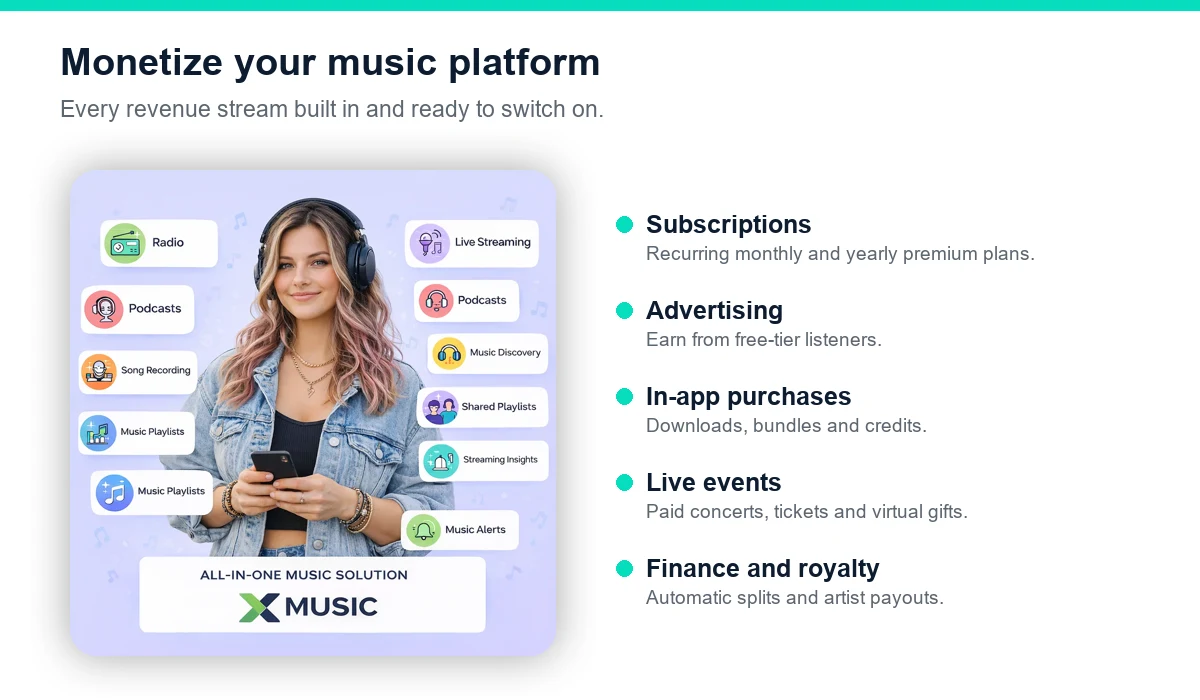
1. Subscriptions: the backbone
Recurring subscriptions are the heart of modern streaming. Listeners pay a monthly or yearly fee for an upgraded experience: no ads, higher audio quality, unlimited skips and offline downloads. Subscriptions are valuable because they are predictable; every renewal is income you can count on, which makes the whole business easier to plan.
Most services offer a small ladder of plans, for example:
- Individual for a single listener.
- Family or duo for a household at a shared price.
- Student at a discount to win younger users early.
- Annual at a saving, which locks in a year of revenue up front.
The platform charges each card automatically on renewal, handles upgrades and cancellations, and records every transaction, so you are never chasing payments by hand.
2. Advertising: earning from free listeners
Only a fraction of listeners ever pay, so the free tier has to earn too. Between tracks, free users hear audio ads, and they see banner or display ads in the app. This does two jobs at once: it generates advertising revenue today, and it reminds free users of the ad-free premium experience, nudging them to upgrade tomorrow.
Ad income can come from your own direct deals with brands, from advertising networks, or both. The more engaged your audience and the clearer your niche, the more a sponsor will pay to reach them.
3. In-app purchases and one-off sales
Beyond subscriptions, listeners will pay for individual extras. Common purchases include:
- Track and album downloads to keep permanently.
- Exclusive or early-release content from favourite artists.
- Credit bundles spent on downloads or features.
- Merchandise tied to artists and events.
These sales suit listeners who do not want a full subscription but will happily pay for something specific. They also give artists another way to earn directly from fans.
4. Live streaming and ticketed events
Live audio and video concerts have become a serious revenue stream. A platform with a live module can sell tickets to virtual concerts, listening parties and interviews, and accept tips or virtual gifts during a show. Because a live event is time-limited and exclusive, fans will pay for access they cannot get any other way, and the sense of occasion drives strong one-off income.
5. Sponsorships and branded playlists
As your audience grows, brands will pay to be associated with it. That can mean a sponsored playlist, a branded radio station, a promoted artist or a season of a podcast backed by a sponsor. For a service with a well-defined niche, sponsorship can be one of the most profitable streams precisely because the audience is focused and valuable to the right partner.
6. Royalty share and commissions
If artists and labels earn on your platform, you can take an agreed commission on their earnings. This aligns everyone's interests: creators keep most of what they make, and the platform earns a share for providing the audience, the technology and the payments. On multi-artist services this becomes a meaningful, scalable income stream.
How the software collects and splits the money
All of this would be impossible to manage by hand. The platform's finance module is what makes the model work in practice.
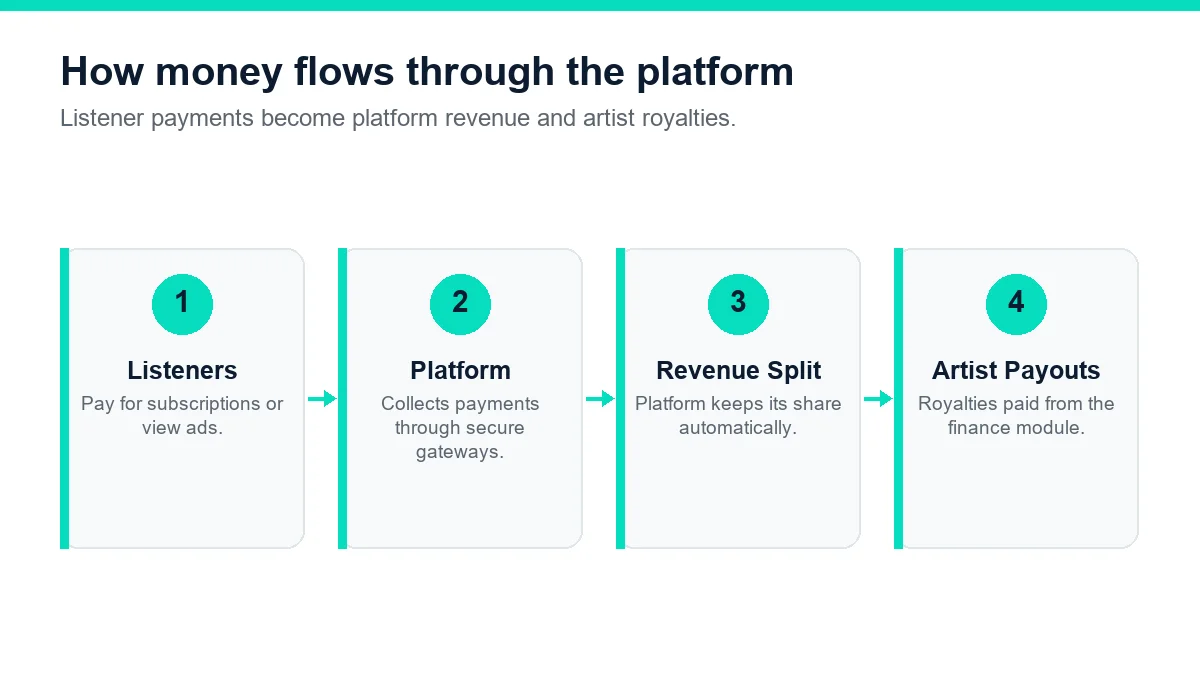
- Listeners pay through a secure gateway, or generate ad revenue by listening free.
- The platform records every subscription, purchase and ad payment in one ledger.
- The revenue split is applied automatically, so the owner's share is separated from what is owed to creators.
- Artist payouts are calculated from play counts and sales, ready to be paid out with a clear audit trail.
In X-Music, the finance and royalty module handles payment logs, subscription tracking, advertising revenue and artist payouts, and exports detailed reports to PDF and Excel for your accounts.
Free versus premium: getting the balance right
The relationship between your free and paid tiers is the engine of the whole model, and it is easy to get wrong in either direction. Make the free tier too generous and nobody upgrades; make it too limited and you lose the audience that advertising and word of mouth depend on. The sweet spot is a free tier that is genuinely useful but has clear friction, such as ads between tracks, standard audio quality and no offline downloads, so that regular listeners feel a natural pull towards premium. Every limitation on the free tier should map to a benefit on the paid one, so the upgrade feels like an obvious trade rather than a punishment.
How to price your subscription plans
Pricing is part research, part psychology. A few principles hold up well:
- Anchor to your market. Look at what comparable services charge locally, not globally. A price that works in one country can be far too high in another.
- Make annual the obvious deal. Offer a clear saving for paying yearly. It improves cash flow and keeps subscribers for longer.
- Offer a family or group plan. Shared plans raise the revenue per account and are harder to cancel because several people rely on them.
- Use a student or intro price. Winning younger listeners cheaply now builds loyal, full-price subscribers later.
- Keep the ladder short. Two or three plans convert better than a confusing wall of options.
Keeping subscribers: the quiet half of the business
Winning a subscriber is only worthwhile if you keep them. The slow leak of cancellations, called churn, decides whether your revenue grows or stalls. The platform helps you fight it with the data and tools to act:
- Watch the signals. Analytics reveal when listening drops off, which often comes before a cancellation.
- Keep the catalog fresh. New releases, playlists and exclusives give people a reason to stay subscribed.
- Smooth the billing. Automatic retries on failed cards and clear renewal reminders prevent accidental cancellations.
- Win people back. A well-timed offer to a lapsed subscriber often costs far less than finding a brand-new one.
Mistakes that leave money on the table
- Relying on a single revenue stream. Subscriptions alone are fragile; advertising and purchases cushion the quiet months.
- Treating the free tier as a cost. It is an advertising audience and a subscriber pipeline, not a loss.
- Ignoring annual plans. Monthly-only billing means more churn and weaker cash flow.
- Never testing price. Small, careful changes to plans and offers can lift revenue significantly over time.
- Skipping the data. Without the finance and analytics modules, you cannot see which stream is working or where money leaks away.
Putting the mix together
There is no single correct formula, but a typical growing service leans on subscriptions for stability, uses advertising to monetize and convert free users, and layers purchases, events and sponsorships on top as the audience matures.
| Revenue stream | Type | Best for |
|---|---|---|
| Subscriptions | Recurring | Predictable core income |
| Advertising | Ongoing | Earning from free listeners |
| In-app purchases | One-off | Fans who want extras, not a plan |
| Live and events | One-off | High-value, time-limited access |
| Sponsorship | Deal-based | Focused, valuable audiences |
| Royalty share | Commission | Multi-artist platforms |
How much do services earn per listener?
It is tempting to look for a single magic number, but earnings per listener depend on your mix. A paying subscriber brings in their full monthly fee, minus payment processing. A free listener brings in a smaller, variable amount from the ads they hear, which adds up across a large audience. The figure that really matters is the blended average across all your listeners, paid and free together, because it tells you how much each new person is worth and therefore how much you can afford to spend to attract them. As your premium conversion rate climbs, that blended figure rises, which is why nudging free users towards paid plans is the most valuable growth lever you have.
A simple worked example of the revenue mix
Numbers make the model clearer, so picture a small but healthy service. Imagine it has a community of listeners, most of them on the free tier and a minority paying for premium. The paying members provide a steady base of recurring income every month, income you can predict and plan around. The much larger free audience, meanwhile, generates advertising revenue each time they listen, and a small share of them upgrade to premium every month as they fall in love with the catalog. On top of that base, a handful of paid live events through the year and the occasional track or bundle purchase add welcome spikes of income. No single part of this is dramatic on its own, yet together they compound: the subscribers from earlier months keep paying while new ones join, the advertising grows with the audience, and the events become more profitable as the community gets bigger. This is the quiet power of the mixed model. You are not betting the business on one source; you are building several streams that reinforce one another, which is exactly what makes streaming a resilient, scalable business rather than a gamble.
Getting advertising right
Advertising is easy to do badly. Too many ads, or jarring ones, drive listeners away and undermine the premium experience you are trying to sell. A measured approach earns more over time:
- Keep the frequency comfortable. A few well-placed ads keep free users listening; a barrage sends them elsewhere.
- Match ads to your audience. A focused niche lets you sell sponsorships directly to brands that want exactly those listeners, usually at better rates than open networks.
- Make ads a reason to upgrade. A tasteful prompt that premium removes the ads turns the free tier into a sales funnel.
- Mix direct and network ads. Direct deals pay more; networks fill the gaps. Using both keeps revenue steady.
Done well, advertising is not just income in its own right; it is the engine that converts free listeners into subscribers.
A recurring business built on a one-time cost
There is a pleasing economics to this model that is worth appreciating. The software that runs the whole operation is a one-time purchase, yet the revenue it enables is recurring. Once the platform is paid for and installed, every new subscriber adds to a stream of income that renews month after month, while your main ongoing costs are modest hosting and your marketing. In other words, you invest once in the engine and then earn repeatedly from it. That is the opposite of renting a platform, where the costs recur alongside the revenue. It is also why owning capable software, rather than paying a share of every sale to someone else, compounds so strongly in your favour as the audience grows.
Turning the model into your business
The business model behind streaming is well understood and repeatable, and the software is what makes it run without an army of staff. With a platform such as X-Music, every one of these streams is built in and ready to switch on, and the finance module keeps the accounting straight as you grow. If you would like help choosing the right mix for your audience and setting it up, message our team, and read how to start a music streaming service for the full launch plan.