


Whether you run a restaurant group in Manchester, a fitness studio in Bristol, a property business in London or a startup anywhere in the UK, an app can turn occasional customers into loyal ones. But UK agency quotes for even a modest app can be daunting, and the UK has strict rules on privacy, marketing consent and children's data. This guide explains how app development works for UK businesses, which rules matter, what drives cost, and how CodeX Link delivers professional apps online at a lower cost while keeping you in control.
iPhone and Android in the UK
The UK smartphone market is roughly balanced between iPhone and Android, with iPhone especially strong in London and among higher-income customers. Almost every consumer app should therefore launch on both. Cross-platform frameworks such as Flutter let us build both apps from one codebase, which reduces cost and keeps features in sync.
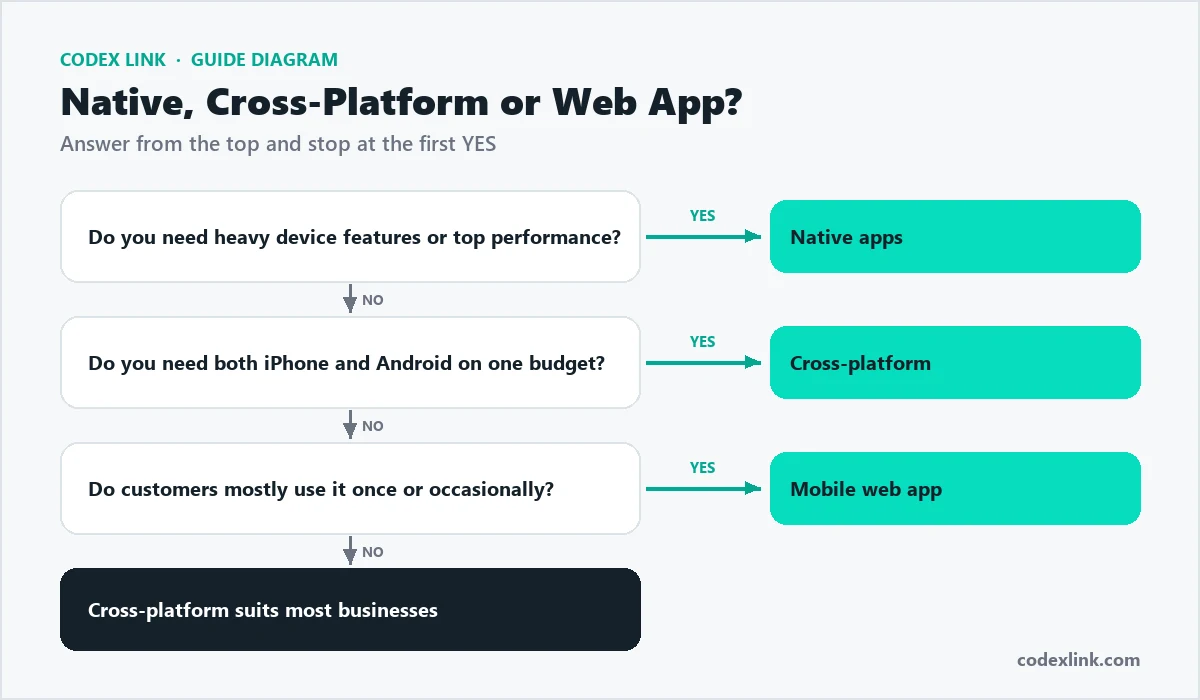
Tip: If customers only use your service occasionally, a fast website may be the better investment. See our guide to website development in London.
UK rules your app should respect
This is general guidance, not legal advice. Check the details with a UK solicitor or adviser, and see the ICO's guidance.
UK GDPR and the Data Protection Act 2018
Apps that process personal data must follow UK GDPR principles: have a lawful basis for processing, collect only what you need, explain it clearly in a privacy notice, keep data secure and respect users' rights to access and delete their data. Most organisations that process personal data must also pay the data protection fee to the Information Commissioner's Office (ICO), unless they are exempt.
PECR: cookies, push and marketing
The Privacy and Electronic Communications Regulations (PECR) cover cookies and similar technologies, including many analytics and advertising SDKs in apps, and electronic marketing by email and text. Non-essential tracking generally needs consent, and marketing messages need consent or a valid "soft opt-in" with an easy way to opt out.
First launch
  "Can we use analytics to improve the app?"   [Allow]  [Not now]
  "Send me offers and news by email"            [ ] unticked
Settings > Privacy
  Analytics: On/Off   Marketing: On/Off   Delete my account
The Children's Code
The ICO's Age Appropriate Design Code, known as the Children's Code, applies to online services likely to be accessed by children under 18 in the UK. It requires high privacy settings by default, minimal data collection, no nudging children to weaken their privacy, and geolocation off by default. If young people might use your app, we design for the Code from the start.
Online Safety Act 2023
Apps that let users share content or message each other, such as community, marketplace or social apps, may have duties under the Online Safety Act, including assessing and reducing risks of illegal content and protecting children. Ofcom regulates these duties. Moderation tools, reporting features and clear terms help meet them.
Accessibility
The Equality Act 2010 requires service providers to make reasonable adjustments for disabled people. We build with VoiceOver and TalkBack support, scalable text, good contrast and clear labels.
Note: Apple and Google also require a privacy policy, accurate privacy labels and an in-app account deletion option for apps with user accounts.
Payments in UK apps
- Apple Pay and Google Pay: very widely used in the UK and the quickest checkout.
- Cards: through Stripe, Adyen, Square or similar providers, with Strong Customer Authentication handled by the provider.
- Buy now, pay later: Klarna and Clearpay are popular in retail.
- Open Banking payments: pay-by-bank options for larger payments.
- Subscriptions: digital subscriptions sold in the app usually use Apple and Google in-app purchases, while physical goods and real-world services can use your own processor.
VAT at 20% applies to most UK sales by VAT-registered businesses, so show prices clearly and check your obligations with your accountant.
How to choose an app development partner
Before you sign with any developer, ask:
- Can you show apps you have built, and what did you do on them?
- Will I receive a written scope, fixed price and milestones?
- Will I own the code, accounts and data from day one?
- How do you handle UK GDPR, consent and accessibility?
- How do you test, and on which devices?
- What support do you offer after launch, and at what cost?
Clear answers show an experienced team. Vague answers about ownership, compliance or testing are warning signs.
Popular app types for UK businesses
Hospitality
Restaurants, cafes and pubs use ordering, table booking and loyalty apps, reducing reliance on delivery platform commissions.
Health, fitness and wellbeing
Gyms, studios, physiotherapists and private clinics use booking, membership and programme apps. Health data counts as special category data under UK GDPR and needs extra care.
Property
Letting agents and property managers use apps for listings, viewings, maintenance requests, documents and tenant communication.
Trades and field services
Contractors and service companies use apps for job scheduling, photos, digital signatures, certificates and invoicing.
Education and training
Tutors, training providers and schools use apps for courses, progress tracking and parent communication, often subject to the Children's Code.
Startups and community platforms
Marketplaces and community apps need profiles, messaging, payments and moderation tools that support Online Safety Act duties.

What does app development cost in the UK?
UK agencies often charge high day rates, which makes even a simple first version expensive. CodeX Link works online from Pakistan with a professional team, so we can offer much lower prices. Every client receives a fixed quote after a free consultation. The main cost drivers are:
- Scope: screens, features and user roles in the first version.
- Backend and admin: dashboards, reporting and content management.
- Integrations: payments, booking systems, CRM, accounting software such as Xero, maps or existing APIs.
- Compliance: consent flows, Children's Code design, moderation tools and security.
- Design: standard UI or a fully custom brand experience.
- Maintenance: hosting, monitoring, OS updates and support.
| App size | Typical example | Typical timeline |
|---|---|---|
| Simple | Information, catalogue or booking request app | About 4 to 8 weeks |
| Medium | Ordering, booking or membership app with payments and admin | About 2 to 4 months |
| Complex | Marketplace, community or multi-app platform | 4 months or more |
Tip: Launch a focused MVP, measure how people use it, then invest in the features customers actually want.
Our app development process
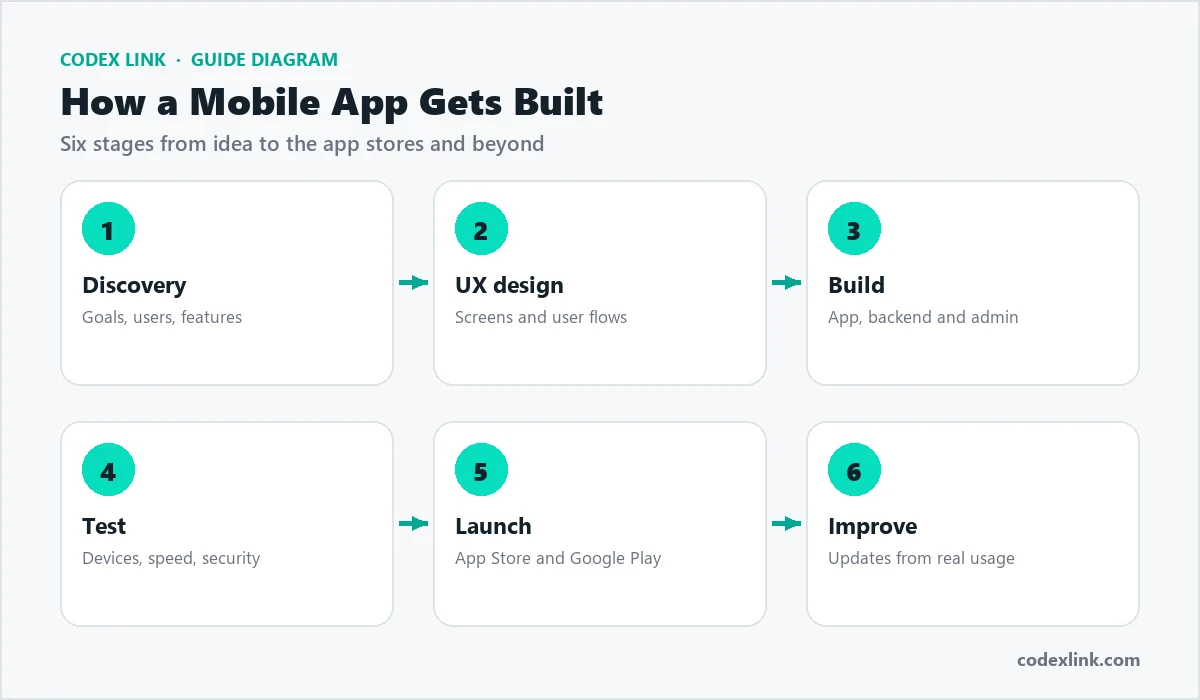
- Discovery: a video call, written scope, fixed quote and milestone plan.
- UX design: clickable Figma prototypes, including consent and privacy screens.
- Build: sprints with TestFlight and Google Play test builds.
- Test: device, accessibility, performance and security testing.
- Launch: store listings, privacy labels and submission.
- Improve: analytics, bug fixes and new features.
Pakistan is four hours ahead of the UK in winter and five hours ahead in British Summer Time, so our afternoons overlap with your mornings, making calls and quick feedback easy.
Technology we use
- Flutter and React Native for cross-platform apps.
- Swift and Kotlin for native features and performance.
- Firebase for authentication, notifications and analytics, configured with consent in mind.
- Laravel and Node.js backends, with UK or EU hosting regions available.
Common app mistakes in the UK
- Analytics before consent: tracking SDKs that start before users agree.
- Pre-ticked marketing boxes: not valid consent under UK rules.
- Ignoring children: apps likely to be used by teenagers without Children's Code protections.
- No moderation: community features without reporting or blocking tools.
- Overbuilding: expensive first versions launched without user feedback.
Security and hosting
Under UK GDPR, you must protect personal data with appropriate security. We use encrypted connections and storage, secure authentication, role-based admin access, logging, regular backups and payment processing through certified providers. If you prefer data to stay in the UK or EU, we use cloud hosting regions there and document where data is stored for your privacy notice.
Running costs after launch
Plan for hosting, push and email services, payment fees, the yearly Apple developer fee, the ICO data protection fee where it applies, and updates for each new iOS and Android release. We estimate running costs in your proposal so your first-year budget is complete.
Who owns the app?
You do. Source code, app store accounts, hosting and data are in your name. We can sign your NDA, and our agreement confirms that you own the intellectual property you pay for.
Working with a remote team
We keep remote projects simple: a written scope, a shared project board, weekly video calls in UK hours, quick messages on WhatsApp or email, and test builds at every milestone. You always know what has been done, what is next and what you are paying for.
Restaurant ordering app: milestone plan
Milestone 1:  Designs and consent screens approved
Milestone 2:  Menu, basket and ordering in test build
Milestone 3:  Apple Pay, Stripe, loyalty and admin panel
Milestone 4:  Accessibility testing, submission and launch
App Store Optimisation and launch
A good app still needs to be found. We prepare store listings with clear names and subtitles, keyword-rich descriptions written in British English, screenshots that show benefits, and privacy labels that match how the app really handles data. After launch, a well-timed review prompt, quick replies to reviews and regular updates help improve ratings and visibility.
Push notifications done right
Push notifications are powerful but easy to overuse. Under UK rules and good practice, marketing pushes should be opt-in, and users should be able to control them in settings. Service messages, such as order updates and booking reminders, are welcome. Promotional messages should be relevant, infrequent and easy to turn off, or users will mute or delete the app.
AI features
Many UK businesses now add AI features such as chat assistants, smart search and recommendations. We integrate AI through secure server-side APIs and update privacy notices to explain how data is used, in line with ICO guidance on AI and data protection.
Web app or mobile app first?
Not every UK business needs native apps on day one. A responsive web app can be the right first step for B2B tools and services used mainly on laptops, while consumer services that customers use often on the move benefit from proper mobile apps. We can share one backend between web and mobile, so starting with one does not mean rebuilding later.
Apps for businesses across the UK
We work with businesses in London, Manchester, Birmingham, Leeds, Liverpool, Bristol, Glasgow, Edinburgh and Cardiff. Wherever you are, the process is the same: a free consultation, a fixed written quote, milestones with test builds and support after launch.
Testing before launch
Before submission, we test on a range of iPhones and Android phones and operating system versions, with larger text, VoiceOver and TalkBack switched on, on slow mobile connections, and with consent choices both accepted and declined, to confirm that analytics and marketing only run when users agree. We also test payment flows, including Strong Customer Authentication, in test mode.
Timeline
Most UK app projects follow a clear rhythm: one to two weeks for discovery and scope, two to three weeks for design, several weeks of development in milestones, then one to two weeks of testing and store review. Having content, branding and decisions ready keeps the project on schedule.
Why choose CodeX Link?
- Professional team of designers, developers and testers.
- Lower cost than typical UK agency rates, with fixed quotes and milestones.
- Privacy-aware design with consent flows, privacy settings and account deletion built in.
- You own everything: code, accounts and data.
- Support on WhatsApp at +92 343 5673902 and by email at support@codexlink.com.
See our mobile app development and custom software services, and our guide to mobile app development in the USA.