
It is obvious that grocery delivery apps sell groceries, but the money behind them is more layered than that. The same app can earn in several ways at once, and knowing them helps you decide whether to run a single store, build a marketplace, or do both. This guide explains how grocery delivery apps make money, which model fits which business, and how to combine them, especially on the thin margins that groceries are known for.
1. Direct product sales (the commission-free core)
The simplest and most important revenue is selling your own products directly on software you own. When a customer orders on your own site instead of a national app, you keep the full order value rather than losing a heavy commission on every basket. On grocery's slim margins, that commission can be the entire profit on an order, so keeping it changes the economics completely.
This is why so many stores build their own platform: the customers were always there, but serving them directly means each order is worth far more. Multiply that across weekly repeat shops, and owning the app pays for itself quickly.
2. Delivery fees
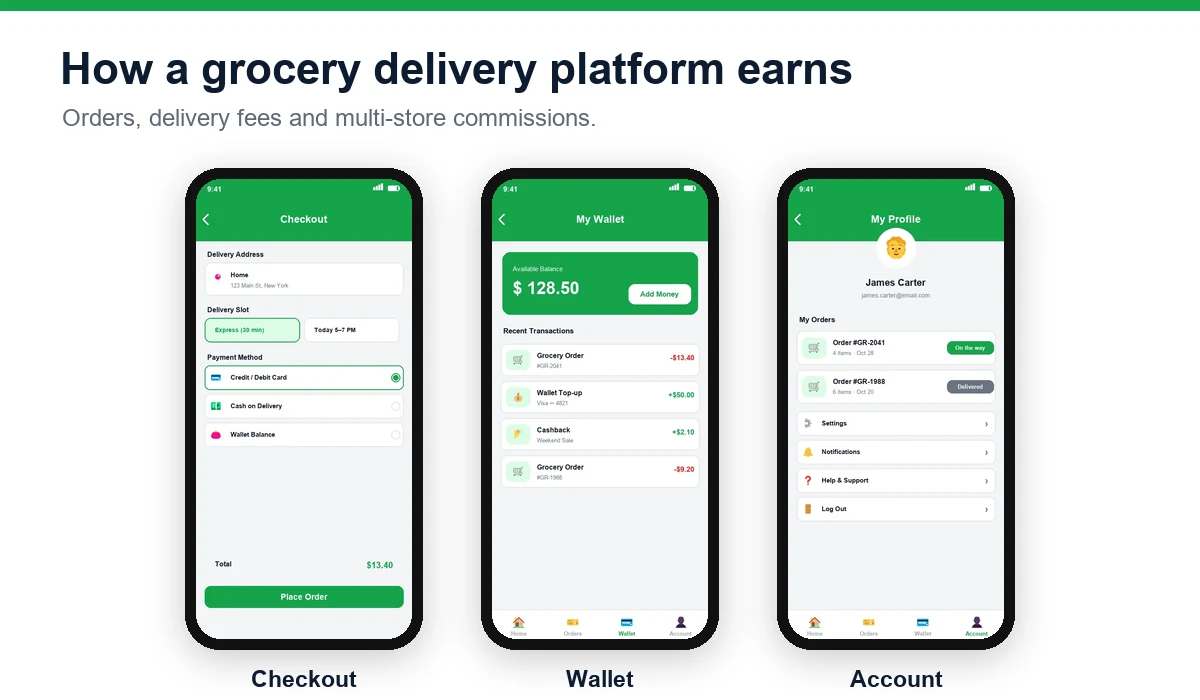
A transparent delivery fee, or a free-delivery threshold that encourages bigger baskets, is a core revenue line. Many stores charge a small fee below a certain order value and offer free delivery above it, which both covers rider costs and nudges customers to add a few more items. Set well, delivery fees turn the cost of getting an order to the door into a revenue stream rather than a loss.
3. Vendor commissions (the marketplace model)
A marketplace earns a commission on other stores' orders without holding any stock. You invite grocery stores, bakeries, pharmacies and specialty shops to list on your platform, and you take an agreed percentage on every order they fulfil through you. The vendors get online reach and delivery tools they did not have to build; you earn from a volume far larger than a single store could produce.
This is how large grocery marketplaces scale. They started with their own or a few partner stores, then grew into platforms earning a slice of thousands of orders a day. With the right software you control commission rates, approve vendors, and manage payouts, all from one dashboard.
4. Service and small-basket fees
Many apps add a small, transparent service fee per order, and sometimes a small-basket fee below a minimum value. Because customers are paying for the convenience of delivery to the door, a modest, visible fee is widely accepted. Across high order volume, these fees become a steady line that is separate from the products and delivery themselves.
5. Promoted products and brand advertising
On an app with many products and vendors, visibility is valuable, so you can sell it. Suppliers and vendors pay to have products featured at the top of a category or search, or highlighted in a seasonal campaign. Done tastefully, this adds high-margin revenue while still showing customers relevant items. It is the same model that powers large retail marketplaces, applied to groceries, and it can become one of the most profitable streams as your order volume grows.
6. In-app wallet float and loyalty
When customers top up an in-app wallet to pay faster, that balance sits with the platform until it is spent. Beyond the modest float, the real value is loyalty: a customer with wallet credit returns to your app for their next shop rather than comparing apps. Repeat direct orders are the cheapest revenue you can earn, because you are not paying to acquire the customer again.
7. Subscription delivery passes
A growing model is the delivery subscription: customers pay a monthly or yearly fee for free or reduced delivery on every order. This gives you predictable recurring revenue, and subscribers tend to order more often because they have already paid for delivery. Even a modest pass, priced to cover a few deliveries a month, locks in loyalty and smooths your income across the month.
Which model fits your business?
The right mix depends on what you are building.
| Business type | Primary revenue | Add-on revenue |
|---|---|---|
| Single store | Direct product sales | Delivery fees, service fees, wallet loyalty |
| Chain or multi-branch | Direct sales across branches | Subscriptions, promoted products, offers |
| Multi-vendor marketplace | Vendor commissions | Promoted products, service and delivery fees, ads |
Most successful apps combine several of these rather than relying on one. A single store can add a delivery pass; a marketplace can still run its own private-label products at full margin.
A simple revenue example
Imagine a store taking 100 orders a day. Fulfilled through a national app charging, say, a 25% commission plus a customer fee, much of the margin on each basket disappears. Taken directly on your own platform, you keep it, and you add a small delivery fee and a service fee per order. Now layer in a delivery subscription for your regulars and a few promoted products from suppliers, and the direct channel earns dramatically more per order than the app channel. Scale that across weekly repeat customers, and the app becomes not just an ordering tool but the main engine of your margin.
What you need to earn this way
All of these models depend on owning capable software rather than renting a listing. You need a catalog, inventory and delivery tools to sell directly, commission and payout tools to run a marketplace, fee and subscription options to add margin, a wallet for loyalty, promoted-product slots for advertising, and reports to see where the money is. A ready platform such as X-Grocery includes all of these, so you can switch on whichever revenue models fit your business today and add more as you grow.
Common questions
Do I need to hold stock to make money from a grocery app?
No. A marketplace earns commission on other stores' orders without holding any stock. You provide the software, delivery tools and reach; the vendors provide the products.
Are delivery and service fees worth charging?
Yes, when kept small and transparent. Customers accept modest fees for the convenience of delivery, and across volume they cover rider costs and add margin on thin grocery baskets.
How quickly can a grocery app become profitable?
For a single store, the commission saved on direct orders, plus delivery and service fees, often covers a one-time platform cost within a few busy months. A marketplace depends on the vendors and volume you attract.
Why owning the platform beats renting a listing
It is worth pausing on why ownership sits at the heart of every revenue model here, because on grocery's thin margins it matters even more. When you rent a spot on a national delivery app, you are a line in someone else's catalog: they set the commission, they own the customer, and they can change the rules or your visibility whenever they choose. Your prices, your branding and even your access to your own sales data are limited by their platform, and the commission they take can be the entire profit on a basket. When you own the software, every one of those constraints disappears. You decide the prices, fees, offers and the look of every screen. You hold the customer relationship, so you can market to past buyers directly and for free. You keep the full order value on direct sales instead of surrendering a slice of each one. And because a platform such as X-Grocery comes with the full source code, you are never at the mercy of a provider who might raise prices or change terms. Ownership is the practical foundation that makes all the other ways of earning possible and keeps the margin on your side, which is exactly what a low-margin business needs.
Keeping costs low on thin grocery margins
Groceries are famously low-margin, so what you keep after costs is everything, and a platform you own helps on that side too. The largest avoidable cost for many stores is the commission paid to national delivery apps, which is exactly what your own platform removes on direct orders. Beyond that, automation keeps running costs lean: automatic confirmations, delivery alerts and refunds mean a small team can handle a busy order flow, and a single dashboard replaces several manual systems. Efficient delivery zones and slots stop riders making wasteful trips. Because a ready platform is a one-time purchase rather than monthly software rent, your ongoing software cost is mostly affordable hosting and per-transaction payment fees. The discipline is to let the software handle the repetitive work, route deliveries efficiently, and reinvest the saved commission into winning more direct orders, which is how a thin-margin business becomes a profitable one.
Increasing average order value
On slim margins, getting each customer to buy a little more makes a large difference to profit, and the software gives you plenty of gentle ways to do it. A free-delivery threshold is the classic: customers add items to reach it, lifting the basket while you keep the margin. Bundles and multi-buy offers move more units at a healthy blended price. Related-product suggestions at the cart, such as bread with butter or snacks with drinks, remind customers of things they would have bought anyway. Seasonal and weekly offers bring people back more often, and a well-stocked, well-photographed range encourages a complete weekly shop rather than a few items. None of these feel pushy when done well, because they genuinely help the customer complete their shop, and each one quietly raises the value of an order you were already fulfilling.
Turning first orders into weekly habits
Winning a customer once is expensive; keeping them is cheap, and in grocery the repeat shop is where the real money is. Because you own the customer data, you can encourage the second order in ways a big app never lets you. A saved basket and wallet make reordering effortless. A thank-you message after the first delivery, with a small discount on the next order, brings people back. Email and push about offers and new products reach customers who already trust you, at almost no cost. A loyalty reward or delivery subscription gives regulars a reason to keep choosing you. Reliable delivery, time after time, is what earns the habit in the first place. Each repeat order carries no acquisition cost, so it is close to pure margin, which is why the most profitable grocery apps focus as much on keeping customers as on finding new ones.
Earn from every model with X-Grocery
X-Grocery supports every revenue model in this guide from one dashboard: commission-free direct sales, delivery and service fees, vendor commissions and payouts for a marketplace, promoted products, an in-app wallet and subscription options, all built on Laravel with the source code included. Packages start at $299 one-time, with Professional at $599 and Enterprise at $1000 for large marketplaces, each with six months of support. See how it works and request a demo on the X-Grocery product page, and read our guide on how to start an online grocery delivery business to put it into practice.
In short
Grocery delivery apps make money through direct product sales, delivery and service fees, vendor commissions, promoted products, wallet-driven loyalty and subscription passes, usually several at once. The common thread is ownership: when you own the app, you keep the margin that big apps would take and you decide how to earn on top of it. Choose software that supports every model, and your app grows from an ordering tool into a genuine revenue engine, even on grocery's famously thin margins.