Coursera Plus is a subscription that unlocks most of Coursera's catalogue, including courses, Specializations and Professional Certificates from universities and companies such as Google and IBM. Degrees are not included.
Key takeaways
- Coursera Plus is one subscription covering most courses, Specializations and Professional Certificates on the platform.
- It saves money only if you finish more than one programme. A single short course is cheaper bought alone.
- Degrees and some programmes are not included, so check the Plus badge on anything you plan to take.
Coursera sells learning in three ways: single courses, monthly subscriptions to one programme, and Coursera Plus, which covers nearly the whole catalogue for one price. Plus is the one people ask about, usually after noticing that the certificate they want would take five months of payments.
Here's how it works and how to tell whether it's the cheaper route for you.
What Coursera Plus is
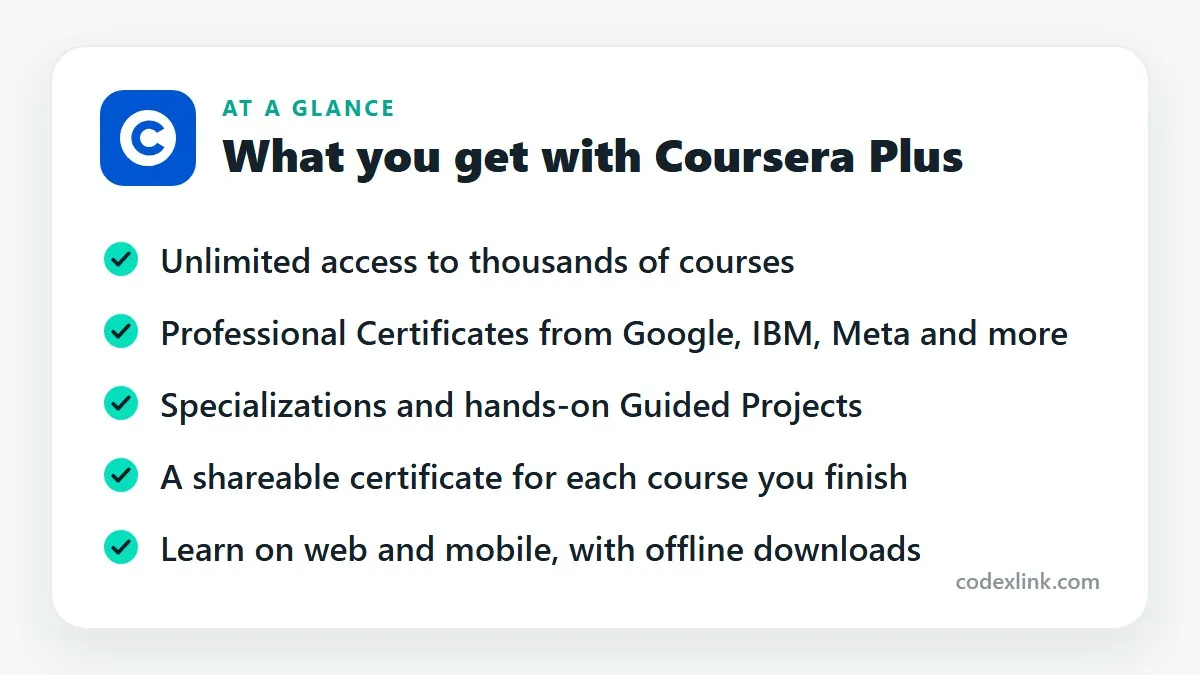
Coursera Plus is a subscription that unlocks most of what's on Coursera. That includes individual courses, multi-course Specializations, Professional Certificates and short Guided Projects, taught by universities such as Stanford, Michigan and Imperial College London and by companies like Google, IBM, Meta and Microsoft.
You can take as many as you like while your subscription is active, and you receive a certificate for each one you complete.
What's included
Courses and Specializations. Thousands of courses across data science, business, computer science, health, languages and personal development.
Professional Certificates. Job-focused programmes such as the Google Data Analytics, Google IT Support and IBM Data Science certificates. These are the main reason many people subscribe, because each one normally takes several months of separate payments.
Guided Projects. Short, practical sessions of one to two hours where you build something in a real tool alongside an instructor.
Certificates. Each completed course gives you a certificate you can add to LinkedIn or a CV.
What isn't included
This matters, and it's where people get caught out.
Full degrees and most MasterTrack programmes are separate. Some courses from specific partners are also outside the subscription. Coursera marks included content with a Plus badge, so look for that on the course page before you subscribe for a particular programme.
A certificate is also not a university credit unless the programme says so. Professional Certificates are well regarded by many employers, particularly for entry-level technical roles, but they are not degrees.
Is it worth the money?
It comes down to how much you'll finish.
If you want one four-week course, pay for that course. If you're planning a Professional Certificate that takes four to six months, or you want to work through several subjects in a year, Plus usually costs less than paying programme by programme.
The risk is the usual one with subscriptions. People sign up with good intentions and complete nothing. Be honest about the time you have. Five hours a week is enough to finish most Professional Certificates within their suggested timeline.
How to get value from it
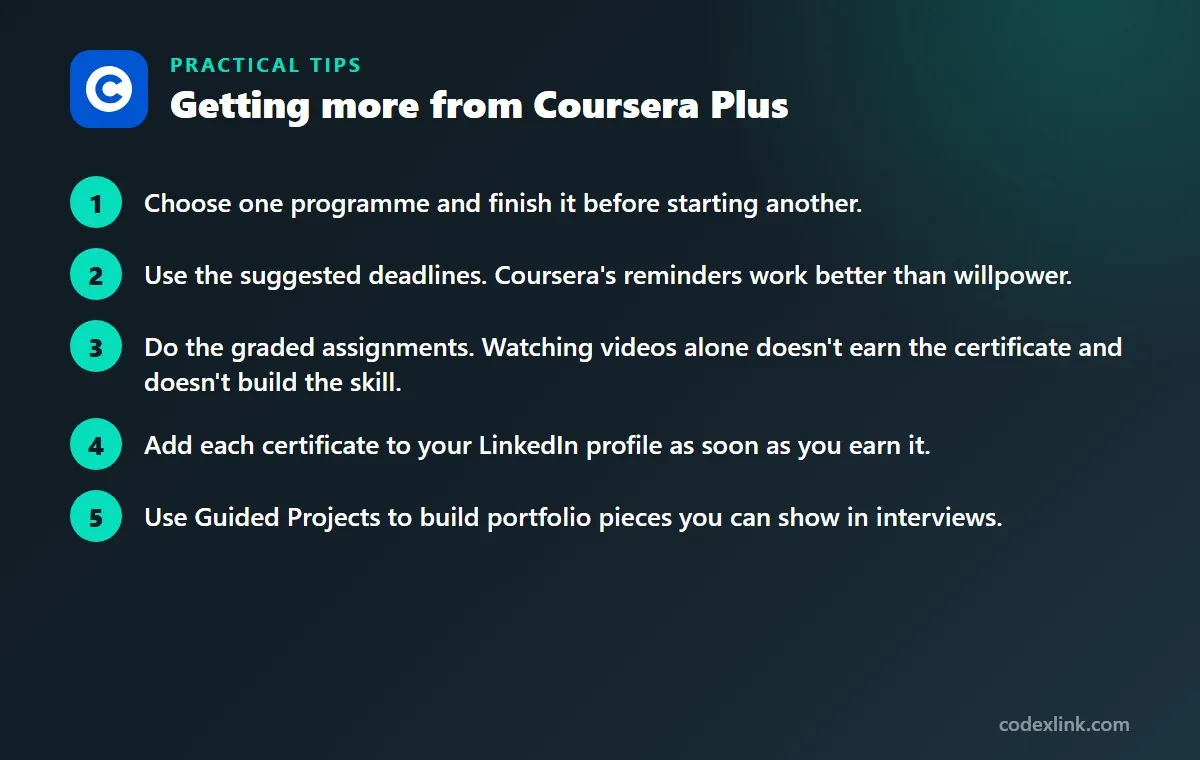
- Choose one programme and finish it before starting another.
- Use the suggested deadlines. Coursera's reminders work better than willpower.
- Do the graded assignments. Watching videos alone doesn't earn the certificate and doesn't build the skill.
- Add each certificate to your LinkedIn profile as soon as you earn it.
- Use Guided Projects to build portfolio pieces you can show in interviews.
Coursera Plus availability and pricing around the world
Coursera is an online platform, so Coursera Plus works anywhere you have an internet connection. In many countries the price is shown in local currency, and it can be lower than the US price.
Most courses are taught in English, with subtitles in a range of other languages, and a growing number are offered with translated or dubbed versions. Check the language options on a course page before you rely on it.
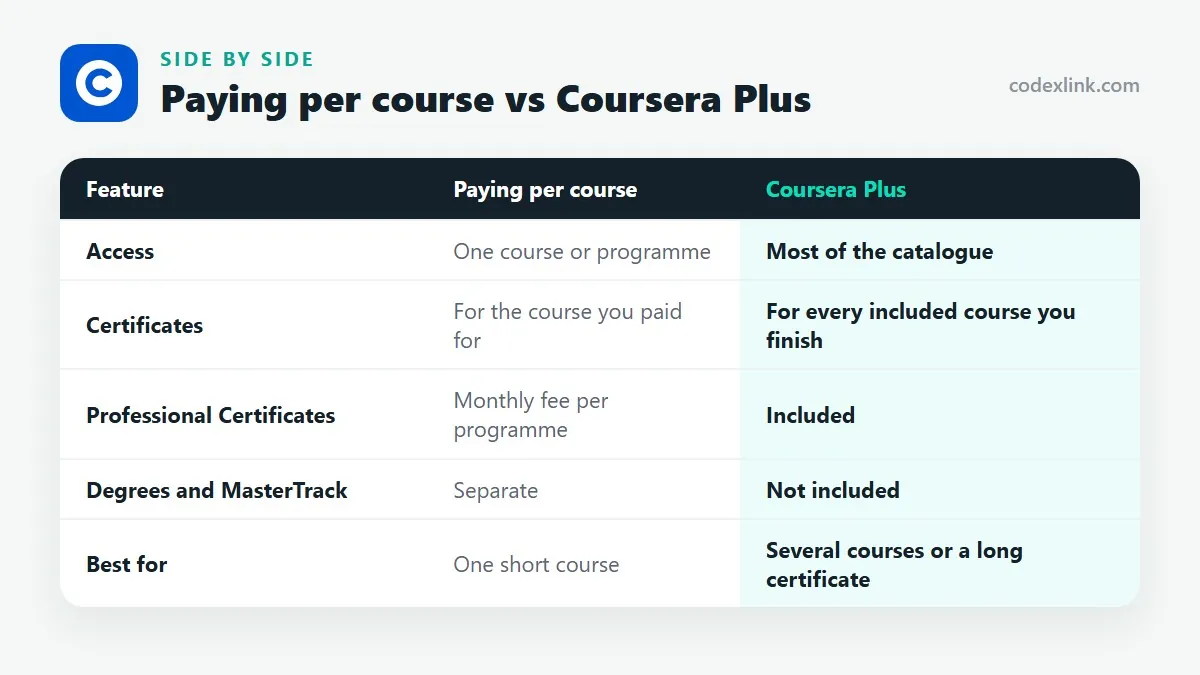
Paying per course vs Coursera Plus: quick comparison
| Feature | Paying per course | Coursera Plus |
|---|---|---|
| Access | One course or programme | Most of the catalogue |
| Certificates | For the course you paid for | For every included course you finish |
| Professional Certificates | Monthly fee per programme | Included |
| Degrees and MasterTrack | Separate | Not included |
| Best for | One short course | Several courses or a long certificate |
Coursera Plus pros and cons
Pros
- One price for thousands of courses
- Covers career certificates from Google, IBM and Meta
- Certificates are shareable on LinkedIn
Cons
- Degrees and some partner courses are excluded
- Only saves money if you finish more than one programme
- Easy to subscribe and not complete anything
Getting started with Coursera Plus, step by step
- Choose one goal, such as "become a data analyst" or "learn project management", rather than browsing randomly.
- Pick a Professional Certificate or Specialization that matches the goal; they are structured paths with projects.
- Set a weekly schedule, for example five hours across three evenings, and add it to your calendar.
- Complete graded assignments and projects, because the certificate and the skills both come from finishing them.
- Add certificates to LinkedIn as soon as you earn them. See our LinkedIn roadmap.
Popular learning paths on Coursera
- Data analytics: spreadsheets, SQL, Tableau and R or Python, with portfolio projects.
- Project management: planning, Agile and Scrum fundamentals, useful for many careers.
- IT support and cybersecurity: entry paths into technical jobs.
- Digital marketing and e-commerce: SEO, social media, analytics and online stores.
- AI and machine learning: from beginner AI literacy to technical machine learning courses.
- UX design: research, wireframing and prototyping, often with Figma. See our Figma guide.
Employers value what you can show, so build a small portfolio from course projects and link it from your CV and LinkedIn profile.
Alternatives to Coursera Plus
- LinkedIn Learning: short practical courses, included with LinkedIn Premium. See our LinkedIn Learning guide.
- Udemy: pay per course, huge variety, quality varies by instructor.
- edX: university courses and programmes, similar to Coursera.
- Free resources: official documentation, YouTube channels and free courses for self-directed learners.
Compare them in Coursera Plus vs LinkedIn Learning vs Udemy.
Mistakes to avoid
- Enrolling in too many courses at once and finishing none.
- Skipping projects: projects are what prove your skills to employers.
- Not checking inclusion: confirm a programme is part of Coursera Plus before paying extra.
- Leaving certificates hidden: add them to LinkedIn and your CV.
- Learning without a goal: choose courses that lead to a specific job or skill.
Monthly or annual Coursera Plus?
Coursera Plus is sold monthly or annually in most countries, and the best option depends on how fast you study.
- Monthly suits one focused certificate you can finish in a few months.
- Annual suits learners who plan several certificates or study slowly alongside work.
- Some countries see regional pricing, so compare the price shown in your own account.
- Financial aid is available for many individual courses if you cannot afford a subscription.
- Companies can buy Coursera for Business for staff training.
Before subscribing, list the certificates you plan to complete and estimate how many months they will take.
A 12-week Coursera study plan
Most learners finish certificates when they follow a fixed routine. This plan fits around a full-time job with about five to six hours a week.
- Weeks 1 to 2: choose the certificate, set your calendar and complete the first course.
- Weeks 3 to 8: one course every one to two weeks, with notes on key concepts.
- Weeks 9 to 10: complete the capstone or portfolio project.
- Week 11: polish the project and publish it on GitHub, Behance or a personal page.
- Week 12: add the certificate to LinkedIn, update your CV and start applying.
Account security and billing tips
A paid Coursera plan is only useful while your account stays safe and your billing stays under control.
- Use a strong, unique password for your Coursera account and turn on two-step verification where it is offered.
- Never share your login with sellers or colleagues; genuine subscriptions are activated on your own account.
- Note the renewal date in your calendar and check the billing email that confirms each payment.
- Keep invoices for business purchases, as you may be able to claim them as an expense.
- Download or screenshot certificates once earned, and keep the shareable certificate links.
- If you plan to cancel, do it before the renewal date; completed certificates remain in your profile.
Whichever plan you choose, the real return comes from finishing: one completed certificate with a strong project is worth more to employers than five half-finished courses.
Getting Coursera Plus through CodeX Link
Coursera Plus is offered in the CodeX Link marketplace as Coursera Premium. Message the team on WhatsApp for the current price, the subscription length and how access is set up.
How to order
- Choose Coursera Premium on the marketplace.
- Message the team on WhatsApp to confirm the price, plan and activation steps.
- Complete activation and start using it.
Frequently asked questions
Is Coursera Plus worth it?
It is worth it if you plan to complete a Professional Certificate or several courses within the subscription period. For a single short course, buying it individually costs less.
Are certificates included in Coursera Plus?
Yes. You earn a certificate for every included course, Specialization or Professional Certificate you complete while subscribed.
Does Coursera Plus include degrees?
No. Degrees and most MasterTrack programmes are not part of Coursera Plus. Look for the Plus badge on a course page to confirm it's included.
Do employers accept Coursera certificates?
Many do, especially Professional Certificates from Google, IBM and Meta for entry-level roles. They show practical skills but don't replace a degree where one is required.
Do I keep my certificates if I cancel Coursera Plus?
Yes. Certificates you have already earned remain yours. You lose access to course materials you haven't completed.
Can I use Coursera Plus outside the United States?
Yes. Coursera Plus is available to learners worldwide, often with pricing in local currency. Certificates are issued online and can be shared wherever you are.
How much does Coursera Plus cost?
The official price is set by the provider and varies by country, plan and billing period. CodeX Link has special offers on Coursera Premium; ask the team on WhatsApp for today's price.
How do I buy Coursera Plus from CodeX Link?
Choose Coursera Premium on the CodeX Link marketplace, then message the team on WhatsApp to confirm the price and plan. They guide you through payment and activation.
Interested in Coursera Plus?
Chat with the CodeX Link team for the current price and activation details, or browse every tool in the marketplace.
Product names and logos belong to their respective owners. Features and plan details change over time, so confirm the current terms with the provider before you buy.